You Are Working Five Days a Week and Still Not Taking Home Enough
Not because you are bad at dentistry. Because nobody ever showed you the number.
There is a specific dollar amount you need to hit every single workday to fund the life you actually want. Three-day weeks. Eight weeks off a year. No insurance company telling you what your time is worth. That number is called your Magic Number, and most dentists have never calculated it.
Instead, they do what they were told. See more patients. Accept more plans. Open earlier, stay later. And their gross production looks fine on paper while their take-home quietly disappoints them every single month.
That is the volume trap. More patients just means more overhead, more staff, more supply costs, and more chair time — not more profit. The dentists running lifestyle practices are not working harder. They have just stopped chasing volume and started engineering their schedule around one number.
Why Insurance Is the Biggest Tax on Your Income
If you are in-network with PPOs, you are writing off 30 to 50 percent of every procedure before the patient even sits down. Reimbursement rates have barely moved since 1992 while the cost of running your practice has climbed every year.
That gap is not a negotiation problem. It is a structural one. You cannot hit a profitable daily target when an insurance company has already decided what your dentistry is worth.
The dentists who escape this do not cut expenses to improve margins. They reverse-engineer their revenue. They start with the life they want, calculate exactly what it costs, and build a schedule that delivers it in fewer, more valuable patient visits.
The Four-Part Calculation Nobody Taught You in Dental School
Your Magic Number is not a guess or a benchmark from a consultant. It is your number, built from four inputs: how many days you actually want to work, what your ideal personal income looks like including taxes and savings, your real practice overhead, and the hourly value each operatory needs to generate.
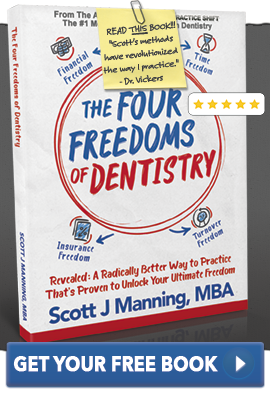
Scott Manning lays out the exact formula in The Four Freedoms of Dentistry, and right now you can claim a free copy.
This is not a lead magnet with a chapter and a pitch. It is the full methodology used by dentists who have cut to three-day weeks without cutting income.
If your schedule feels like it owns you, it does. Claim your free copy and run the numbers.

Frequently Asked Questions
What is the dental practice magic number?
It is the exact dollar amount of dentistry a doctor must produce every workday to fully fund their practice overhead and their ideal personal lifestyle.
What is a good profit margin for a solo dentist?
While average dental practices operate at an 18 to 30 percent margin, a highly optimized lifestyle dental practice should aim for a 50 percent profit margin.
How do you calculate the dental magic number?
You calculate it by defining your total clinical weeks, reverse-engineering your total revenue goal, extracting your daily goal, and determining your required hourly value.