Your daily production goal isn’t a number you guess. It’s a number you build, starting from the life you actually want, then working backwards through retirement contributions, taxes, and practice overhead until you land on the exact dollar amount your chair needs to produce each day. Most dentists get this completely backwards. They start with their bills, add a little margin, and call that a goal. Scott Manning calls it the “lowest common denominator” approach, and it’s why so many high-producing dentists still feel financially trapped.
Why Your Current Daily Goal Is Probably Wrong
Here’s something uncomfortable. If you picked your daily production number by looking at your overhead and adding 20% on top… you didn’t set a goal. You set a ceiling.
That’s how most dentists operate. They build their target around what the practice needs to survive, not what they need to actually live. The practice keeps running. The bills get paid. But somewhere between the morning huddle and the last crown of the day, the life part of the equation quietly disappears.
The dental industry’s standard benchmark sits around 30 cents of profit on every dollar that flows through a practice. That’s not something to build a goal around. It’s something to escape. Scott Manning teaches his doctors to keep 50 cents on the dollar. That’s not a theory. That’s what reverse engineering your number from your life actually makes possible.
The Two Ways Practices Grow (Only One Works for You)
Before you calculate anything, you need to understand which growth strategy you’re on, because they lead to very different lives.
Growth by Volume
This is the default. More patients. More procedures. More insurance relationships. More transactions per day.
Volume growth maxes out your schedule, your team’s capacity, and eventually your own. It’s not wrong if you want to run a high-throughput operation. But the cost is predictable: overhead climbs with every added procedure, the margin per patient thins out, and burnout follows on a tight schedule. Most dentists discover this around year five or six. They’re busier than ever and somehow taking home less per hour than they were three years ago.
Growth by Value
The alternative is building days around fewer, higher-value appointments. Anchor procedures. Treatment plans that reflect what the patient actually needs, presented in a way that gets acceptance. A schedule that’s designed rather than just filled.
Value-based growth doesn’t require more clinical hours. It requires clearer goals, better case presentation, and a daily target that’s connected to something real. Your actual life. Not a break-even number with a margin tacked on.
That target is what Scott calls the Magic Number.
How to Calculate Your Magic Number: The Reverse Engineering Framework
Work through this in order. Don’t skip steps.
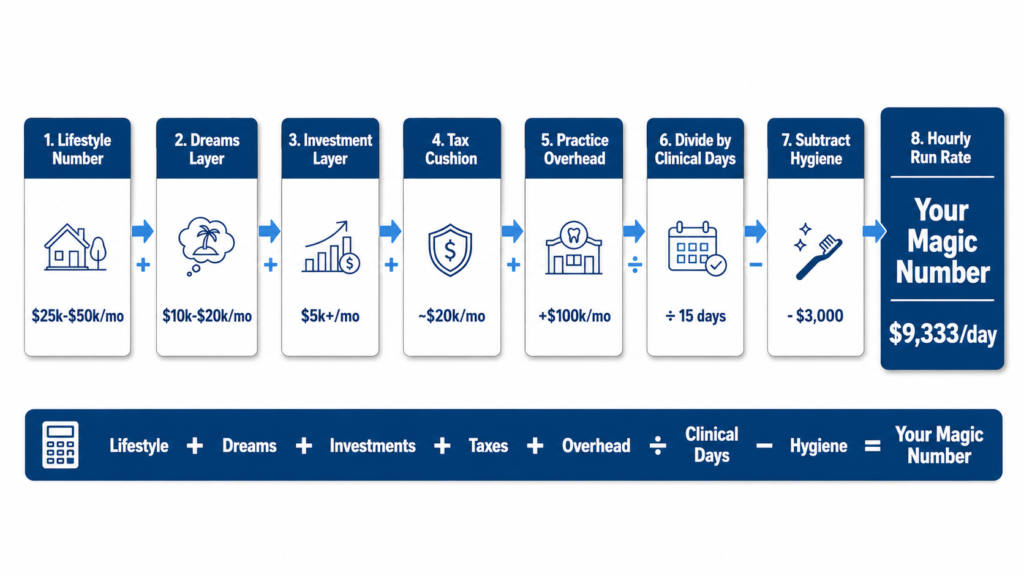
Step 1: Start with Your Lifestyle Number
What do you need to take home every month to actually live the life you want, not the life you’re tolerating?
This isn’t about what you’re currently spending. It’s about what you’d spend if money wasn’t the constraint. Write down an honest monthly number. For most of the doctors Scott coaches, this falls somewhere between $25,000 and $50,000 a month. Whatever yours is, that’s your baseline.
Step 2: Add Your Dreams Layer
On top of lifestyle expenses, add what you actually want: vacations, home improvements, charitable giving, a rental property, funding your kids’ college. This is the category most dentists skip entirely because it feels indulgent. It isn’t. If you don’t build it into the math now, it never makes it into the budget.
A reasonable estimate for this layer is an additional $10,000 to $20,000 per month.
Step 3: Add Your Investment Layer
Retirement funding is not optional. At minimum, you need $60,000 per year going into retirement vehicles: 401(k), cash balance plan, whole life strategy, real estate, or some combination. That’s $5,000 per month before taxes. Scott generally pushes this number closer to double.
Add your investment number to the running total.
Step 4: Account for Taxes
A percentage of everything above is going to taxes. Add a cushion, typically around $15,000 to $20,000 per month for the income levels we’re discussing, depending on your state and structure. Your CPA can sharpen this number once you have the rest dialed in.
Running Total (example):
- Lifestyle: $40,000
- Dreams: $15,000
- Investments: $10,000
- Taxes: $20,000
- Monthly Profit Target: $85,000
Step 5: Add Practice Overhead
Overhead isn’t a percentage. Worth saying clearly. Overhead is a fixed number: payroll, rent, equipment, labs, supplies. Get the actual dollar amount, not a rough estimate.
For most single-doctor practices, monthly overhead falls between $60,000 and $120,000. Using $100,000 for this example:
Monthly Production Target = $85,000 profit + $100,000 overhead = $185,000
Step 6: Divide by Clinical Days
How many days are you actually in the chair per month? Not 20. Probably 12 to 16 for a practice designed around your life rather than around capacity.
Using 15 clinical days: $185,000 / 15 = $12,333 per day
Step 7: Subtract Hygiene Production
If you have hygiene producing in your practice, subtract that from the doctor’s daily number. Two hygienists running at $1,500 per day each equals $3,000.
Doctor’s Daily Target: $12,333 – $3,000 = $9,333
Step 8: Break It Into Hourly Blocks
Working a 7-hour clinical day? That’s roughly $1,333 per hour. You won’t hit that every hour, some hours are slower. But you start the morning with an anchor appointment worth $3,000 to $5,000, and the rest of the day can afford to be lighter. Scott calls this “skinning up the day”: front-loading value so the daily number is essentially done by noon.
One number. One bullseye. Everything else in the practice points at it.
What Changes When You Get This Right
When your daily goal is built this way, something shifts. It stops being arbitrary. It has a reason behind it: your kid’s tuition, your retirement account, the vacation you keep pushing back. Because it’s tied to something real, it’s a lot harder to let it slide.
It also changes how you look at the schedule. You stop asking “how full is the day?” and start asking “what’s the value in the day?” One bad two-hour appointment can blow the whole target. A single well-presented treatment plan can make the day before lunch.
The dentists Scott works with who internalize this, who actually reverse-engineer their number and then run their schedule against it, describe it as the first time dentistry felt genuinely controllable. Not chaotic. Not reactive. Just a target, a plan, and a clear read on whether they’re on track.
Related Questions
What is the Magic Number in dentistry?
The Magic Number is the specific daily production target a dentist needs to hit to fund their lifestyle, retirement, taxes, and practice overhead. Coined by Scott J. Manning, MBA, it’s calculated by reverse engineering from personal financial goals, not from overhead minimums. It’s the foundation of everything taught at Dental Success Today.
How much should a dentist produce per day?
It depends on the individual practice’s overhead and the doctor’s income goals. A single-doctor private practice with 15 clinical days per month and an $85,000 monthly profit target typically needs to produce $9,000 to $13,000 per day at the chair, before hygiene production is factored in. Goals built on industry overhead averages consistently leave the dentist financially short.
What is the difference between value-based and volume-based dentistry?
Volume-based dentistry grows by adding more patients and more procedures, which raises overhead at the same rate. Value-based dentistry grows by increasing the average appointment value through better case acceptance, letting the practice hit the same or higher production with fewer clinical hours and less overhead pressure.
How many clinical days should a dentist work per month?
Scott Manning’s Lifestyle Practice model targets 12 to 16 clinical days per month, enough to reach a seven-figure personal income without running a high-overhead, high-volume operation. The daily production goal is reverse-engineered to make that schedule financially viable.
Ready to Calculate Yours?
The framework above gives you the structure. But working through the actual numbers, your lifestyle target, your investment strategy, your overhead picture, is where most doctors get stuck without someone to pressure-test the math with them.
Scott Manning’s Lifestyle Practice Blueprint call is a complimentary 1-on-1 session where he works through this exact calculation with you, live. If you’ve been running your practice without a real Magic Number, this is the conversation that changes that.