Most dental practices have high staff turnover because they rely on a paycheck to hold their people, and pay is a commodity anyone can find somewhere else. Teams stay when the practice gives them three things money alone cannot: a mission bigger than the job, a clear path to earn more, and a workplace that lifts them up instead of draining them. Turnover is rarely a market problem. It is almost always a culture problem, and culture is the one variable you fully control.
You Cannot Control the Job Market. You Can Control the Grass.
Every dentist asks some version of the same thing. Why do some practices bleed staff every few months while others keep the same people for years? In hard-to-hire regions the excuse is always ready: wages are too high, nobody good is available, the numbers do not work.
Fair enough. You cannot set the regional wage. You cannot fix the labor shortage. The ADA found that roughly 90% of practices call it extremely or moderately hard to find qualified staff, so the squeeze is real and it is not in your head.
Here is what you can control: the ground you plant your team in. Scott Manning has said the same thing his entire career. If you want to grow the practice, grow the people. It is the same logic as patient service. You cannot deliver great care to patients if you do not deliver great care to your team first. That is why the rule at Dental Success Today is simple. Team is patient number one.
The goal has a name. No greener grass. You want the greenest grass on the block so your best people never go looking over the fence. If all you do is dentistry, rush in, rush out, and lean on the paycheck to keep people around, you are farming on land in a drought.
The 3 Things Every Dental Team Member Actually Needs
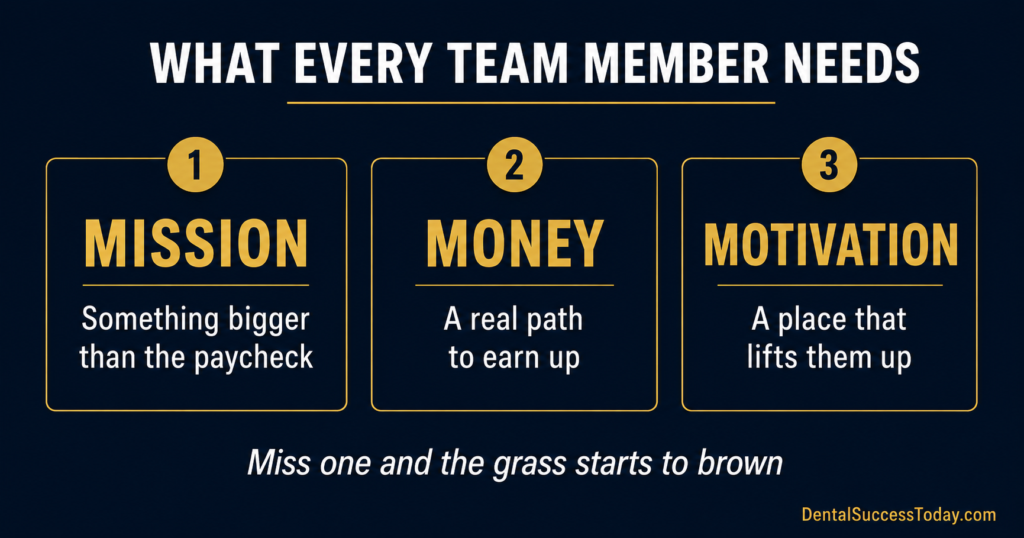
Forget pizza parties for a second. Real retention runs on a trifecta. Mission, money, and motivation. Miss one and the grass starts to brown.
1. A Mission Bigger Than Any One Person
People want to be good at their job. They also want it to mean something past their own paycheck. Think of a sports team. Everyone wants to win their position, and they want to win it for the team, not just for themselves. So get clear on your practice mission. Who do you help, how, and to what degree. When the team rallies around patient outcomes instead of clocking hours, the work itself changes character.
2. A Real Path to Earn Up
Nobody is doing this for fun. People work for their livelihood, and your job is to build the most prosperous ground possible for them to win on. That means a game they understand and can actually win. Here is the uncomfortable part. Any person who has no path to make more money inside your practice will find a path to make more money somewhere else. Count on it. You are always going to be managing one of two people: the unambitious one who has settled, or the ambitious one who wants to climb. Build for the climber.
3. A Place That Lifts People Up
Your practice is doing one of two things to your team every single day. Lifting them up or dragging them down. They feel it, and so do you. A motivating, positive, high-energy room is not a nice-to-have. It is the difference between a team that self-reports and holds itself accountable and one that quietly checks out months before it actually quits. The data backs this up. Gallup’s research links highly engaged teams to about 21% greater profitability and far lower turnover than disengaged ones. Culture is not soft. It shows up on the P&L.
Training vs. Transformation: Why Scripts Do Not Build Great Teams
This is the part most consultants get backwards, and it is where the corporate scheduling model and Scott’s approach split hard.
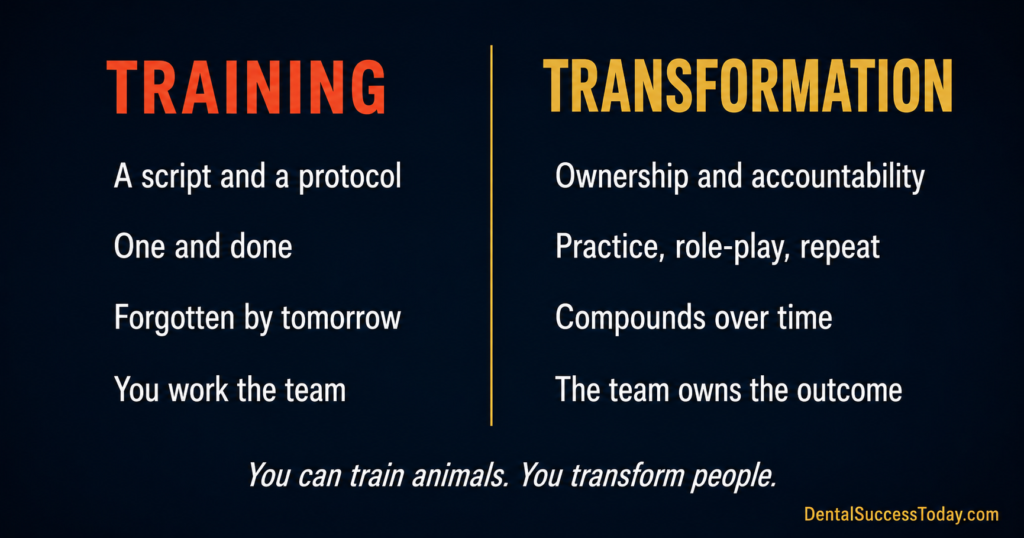
Scott put it bluntly more than two decades ago. You can train animals. Train a dog once and it never forgets. Train a person today and tomorrow they do not remember what they did yesterday.
Training is a piece of paper. A protocol. A script you hand someone and then forget about. Transformation is a different animal. It is positional ownership and performance-based accountability. It works the way a championship sports team works. You develop the skill, then you practice it, role-play it, watch the game film, and keep going. An athlete who is in shape keeps training to stay in shape. Your team is no different.
You still need a baseline of policy and protocol. But paper does not run your practice. People do. More often than not, the templates and policies get in the way of the actual principles and results. What you want is personality and authenticity, not a team reading lines off a card to your patients.
Cross-Training vs. a Team of Experts
This question comes up constantly. The answer is not to make everyone a generalist who does everything badly. It is to build a team of experts who each own their position and back each other up. Ownership beats interchangeability every time.
The Emotional Bank Account: The Real Retention Metric
Scott points to The 7 Habits of Highly Effective People, and one idea inside it matters most here. Stephen Covey’s emotional bank account. Every interaction with a team member either deposits into their account or withdraws from it.
Want to know why people leave or stay? Why they are stagnant or growing? Look at one thing. Is your practice depositing into the emotional bank accounts of your team, or quietly sucking them dry?
Here is a gut check you can run today. When you walk in each morning and leave each night, how do you feel? When one week ends and the next begins, how do you feel? Because the team is always a reflection of the doctor, and the patient is always a reflection of the team. Lowest common denominator, or greatest possible outcome.
Win the Day: The Huddle Is Your Greatest Tool
The single most powerful retention and performance tool you have costs nothing. The morning huddle and the end-of-day huddle. Scott calls them the bookends that win the day.
A real huddle is not reading numbers off a clipboard. It sets the psyche, reminds everyone of the purpose, motivates the team, and lays out the custom battle plan for that day’s patients. The difference between teams that win again and again and teams that just scrape by almost always comes down to the energy, the culture, and a clear playbook for how to win the day.
The full rhythm looks like this:
- Morning huddle: Set the tone and the game plan for the day
- End-of-day huddle: Close the loop, celebrate the wins, reset
- Weekly touch points: Keep the team aligned
- Monthly development: Grow skills and people on purpose
- Quarterly: Set the bigger targets and the tone for the next 90 days
Rinse and repeat. That is the system. Build a complete-health team and the complete-health patients follow. It all begins with patient number one.
Related FAQs
Why does my dental practice have high staff turnover?
Most turnover comes from relying on pay alone to keep people. Pay is a commodity that anyone can find elsewhere. People stay when the practice gives them a mission bigger than the job, a clear path to earn more, and a workplace that lifts them up. Chronic turnover is a culture signal, not a market inevitability.
Will paying my team more fix turnover?
Rarely on its own. Pay has to be fair and competitive, but money is something people can find anywhere. They stay for mission, a path to grow, and a workplace that energizes them. Leaning on pay alone leaves retention up to chance.
What is the difference between training and transformation?
Training hands someone a script or protocol and moves on. Transformation builds ownership and accountability through ongoing practice, the way a sports team keeps drilling and watching game film. Training fades fast. Transformation compounds.
How often should a dental team meet?
Daily morning and end-of-day huddles, weekly touch points, monthly development sessions, and quarterly target-setting. The daily huddles are the highest-leverage habit and the cheapest place to start.
Build a Team That Does Not Want to Leave.
If you are tired of carrying the practice on your own back and rehiring every few months, the fix is not another raise. It is a system. The Lifestyle Practice Blueprint call is where that conversation starts.
Scott Manning works directly with dentists to turn culture into a competitive edge, based on your actual practice, not a generic playbook.