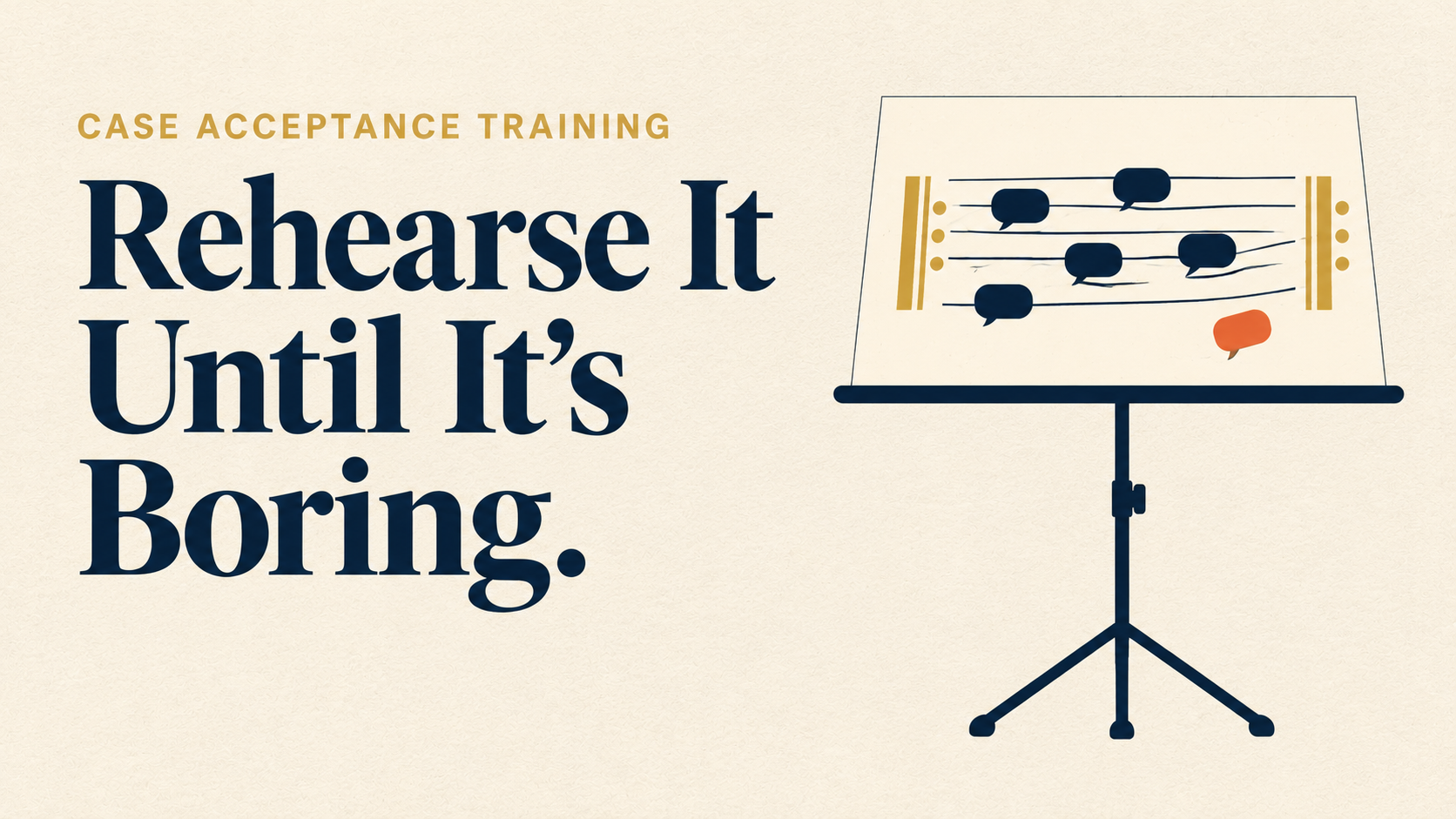
Dental case acceptance training works when you train the whole team on a handful of specific patient conversations and rehearse them every month, not once a year. Pick the conversations where treatment gets lost, role-play them until they feel automatic, and track your acceptance numbers before and after so you know it worked. A weekend course on its own rarely changes what happens in the chair on Tuesday.
Why Most Case Acceptance Training Wears Off
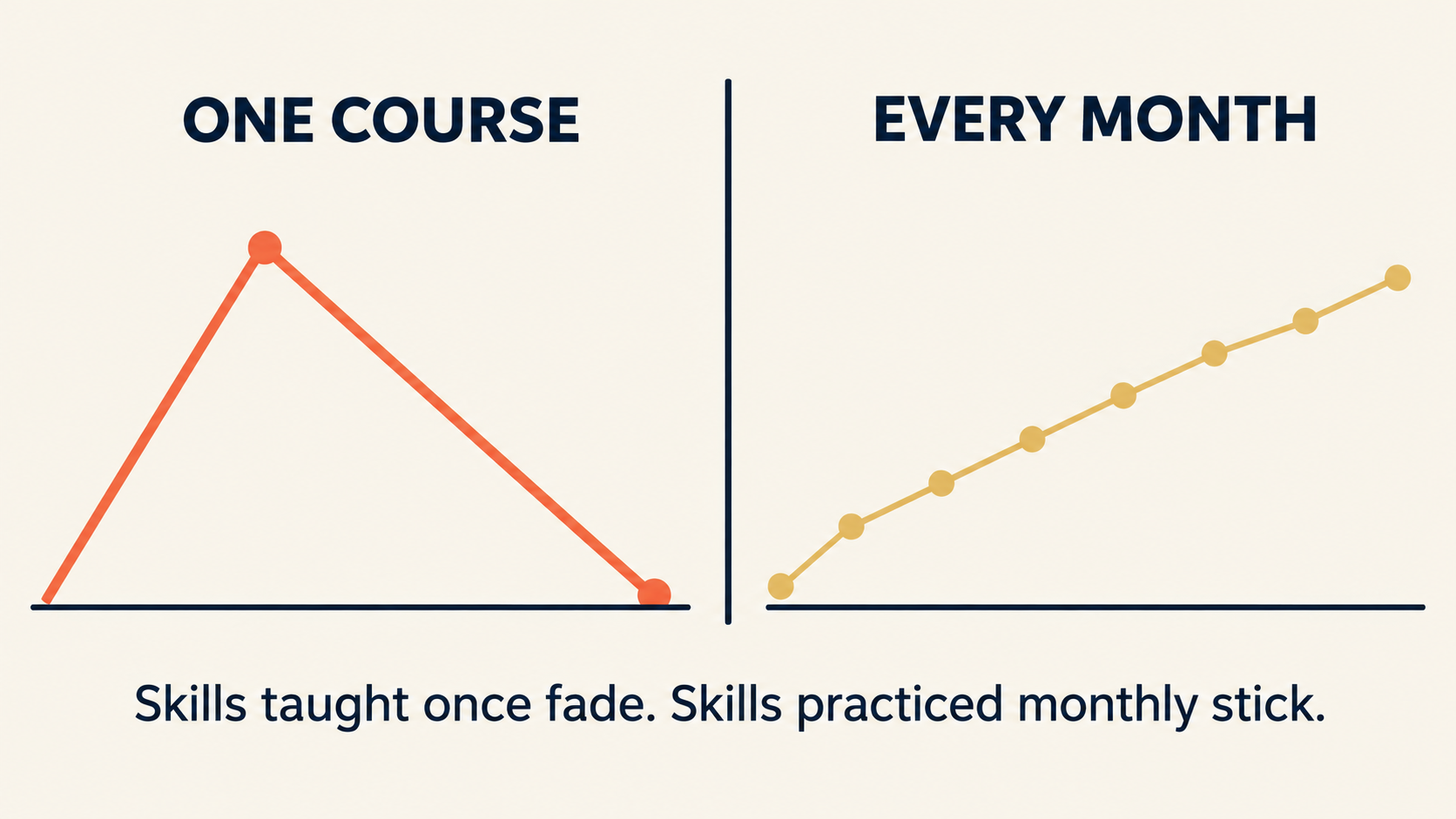
You’ve probably seen this. The team goes to a course, comes back on Monday with a binder and real energy, and for about eight days the new scripts get used. By the third week the practice sounds exactly like it did before.
Nobody did anything wrong. Reading a script once just doesn’t change how someone talks under pressure, with a patient frowning at an estimate and a hygiene patient waiting in the next room.
The research on communication training points the same way, with one caveat worth knowing. In a randomized trial of 160 oncologists in the UK, the skills taught in a communication course were mostly still there a year later. Interruptions kept falling. But expressions of empathy dropped by about half over the same twelve months. That’s cancer care, not dentistry, so treat it as a signal rather than a rule. The signal is useful anyway: the mechanical parts of a conversation can stick, and the warm parts fade unless somebody keeps practicing them.
There’s a second problem. A 2025 review in Dentistry Journal noted that patients recall less than half of the oral health advice their dentist gives them. So the long, thorough explanation your team learned at the course is mostly gone before the patient reaches the parking lot.
Case Acceptance Is a Team Skill, Not a Doctor Skill
Most practices send the doctor and maybe the treatment coordinator to case acceptance training. That misses where the decision actually gets made.
By the time a patient hears about a crown, most of the decision is already locked in. As I wrote on why patients say no to dental treatment, the no usually gets made during the phone call, the intake, the hygiene visit and the exam, long before the presentation. Every person who touches the patient is part of the case.
That includes the small sentences. “We can watch that for now.” “Whenever you’re ready.” A hygienist who says either one has just given the patient permission to wait, and what you tolerate, you train. If nobody addresses it, it becomes the way the whole team talks. The same logic sits behind setting standards patients follow: the team learns the real rules from what you let slide, not from what’s in the handbook.
The Four Conversations Worth Training
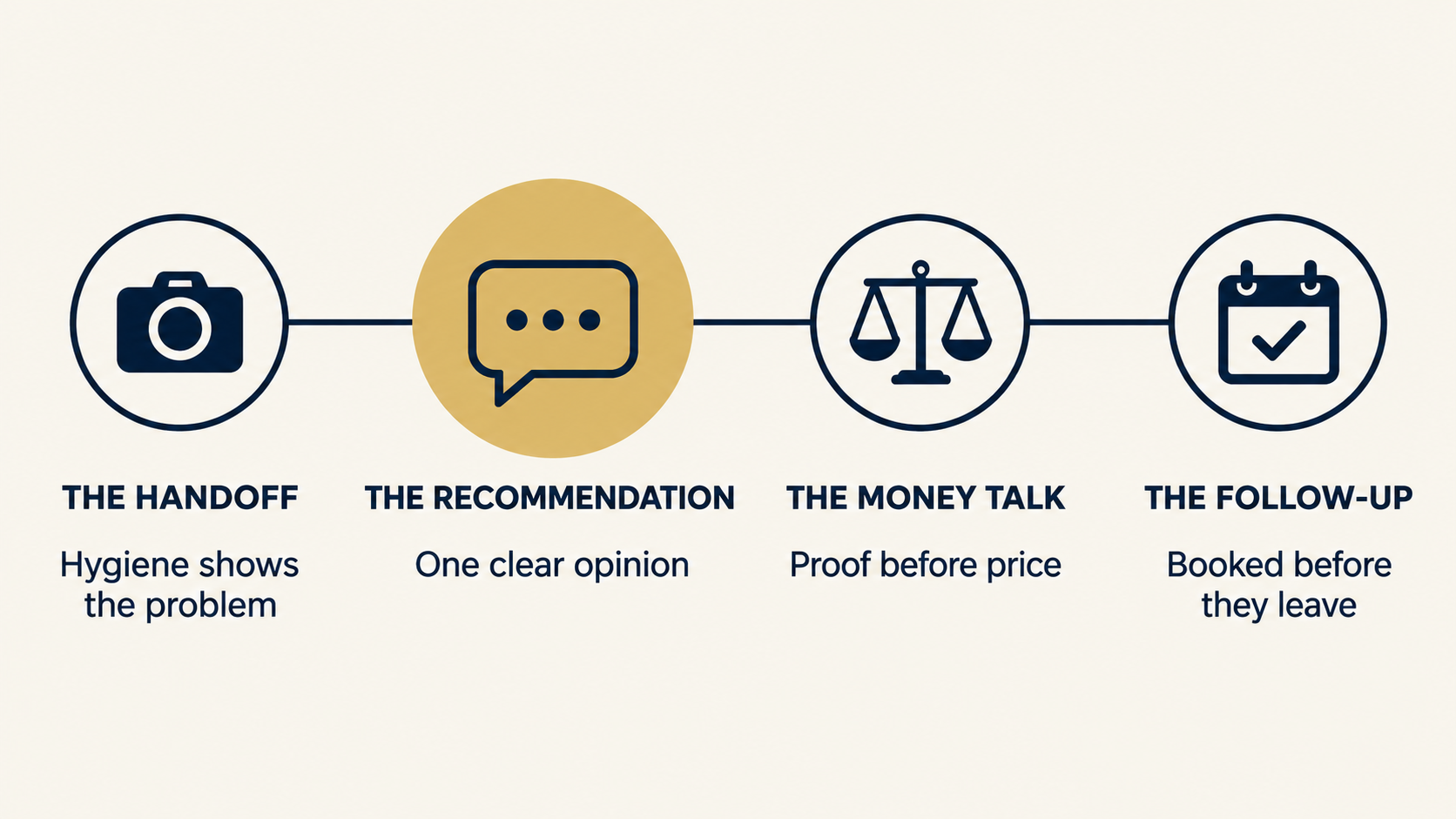
You don’t need fifty scripts. You need four conversations that your whole team can run the same way every time.
The Hygiene Handoff
The hygienist is the first clinician who sees the problem, and the patient usually trusts them more than anyone else in the building. Train the handoff so the hygienist shows the patient the photo, names what they see in plain words, and tells the doctor in front of the patient. “Doctor, I showed Mrs. Lee the crack on the upper left. She’d like your opinion on it.”
The patient now walks into the doctor’s part of the visit already curious, not defensive.
The Recommendation
This is where most practices go wrong, and the fix is one sentence. Stop asking “what would you like to do?” Start saying “here’s what I’d do if this were my mouth, and here’s what I’d do first.”
Handing a patient a list of options and asking them to choose is what I call being an order taker. It feels respectful. To the patient it sounds like none of it is urgent, because surely the dentist would have said so.
Practice the recommendation out loud until the doctor can say it without hedging.
The Financial Conversation
Proof before price. Show the photo, explain plainly what waiting costs, and only then talk about money, once the patient actually wants the treatment.
Most teams run it backwards. They lead with the estimate, watch the patient flinch, and conclude that people around here can’t afford dentistry. Train your financial coordinator to ask one question before quoting anything: “Is this the treatment you want? Then let’s work out how to make it happen.”
The Follow-Up Call
When a patient leaves undecided, the follow-up is often where the decision changes. Train it as a scheduled call, booked before the patient leaves the building, with a named person making it. A follow-up that depends on someone remembering is how diagnosed treatment turns into one of the quietest profit leaks in a dental practice.
How to Run Case Acceptance Training In-House
You can run most of this yourself. It costs time, not a course fee.
Start With a Baseline
Before you train anything, pull your last twenty presented treatment plans. For each one, write down whether it was scheduled, and whether it was presented with a photo and a clear recommendation or mentioned in passing on the way out the door.
That one exercise usually tells you which of the four conversations is broken. It also gives you a number to compare against in sixty days.
Thirty Minutes a Month, One Conversation at a Time
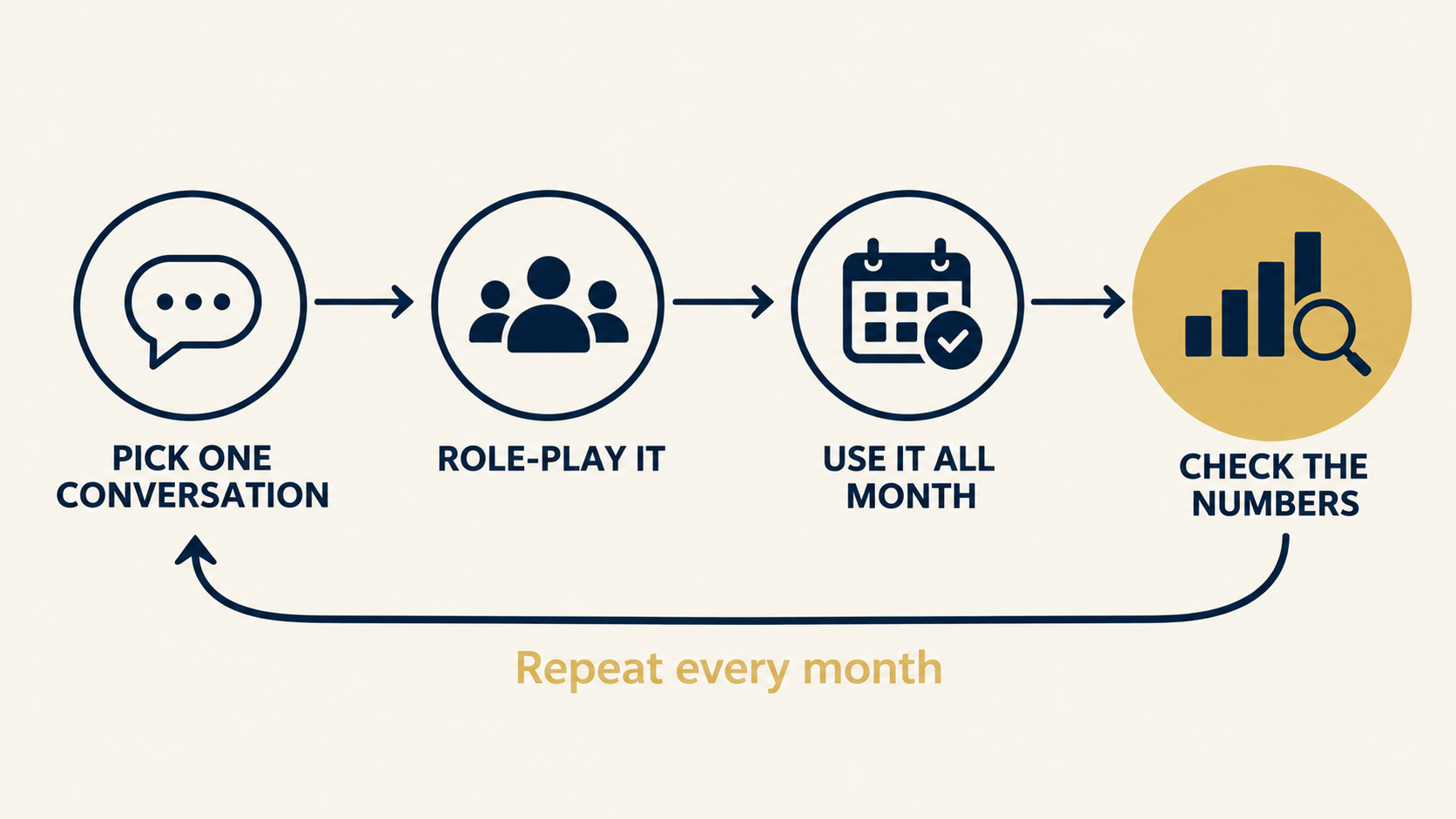
Pick one conversation per month. Spend thirty minutes on it at a team meeting, then use it all month. Next month, pick the next one.
Monthly matters more than long. A full-day workshop once a year is easy to schedule and easy to forget. Short, repeated practice is what turns a script into the way someone actually talks.
Role-Play the Difficult Patient, Not the Friendly One
Have one team member play the patient, and make them hard to deal with. The one who says “I’ll think about it.” The one who heard from a friend that dentists overtreat. The fifteen-year patient who’s offended you’re bringing up money.
It feels a little silly the first couple of times. That passes. Keep going until the answer is boring.
To be honest about the evidence: a 2017 systematic review of 60 studies on simulated patient training found it widely used and generally rated as improving communication, but with limited proof that it changes patient outcomes. That’s exactly why you track your own numbers. The research tells you role-play changes how people talk. Your schedule tells you whether it changes what patients decide.
Use Your Own Photos and Your Own Patients’ Words
Practice with real intraoral photos from your own practice, with identifying details removed, and with the actual objections your patients raise. Write them down for a month. Your patients have their own phrasing, and training against a generic script from another office doesn’t prepare anyone for it.
Keep Empathy in Every Drill
Remember the oncologist trial. The empathy faded first. So every role-play should include one moment where the team member acknowledges how the patient feels before answering the objection. “That’s a lot to take in on a Tuesday morning” before “here’s how the payment works.”
How to Measure Whether It’s Working
Track three numbers every month, and track them by person, not just for the practice.
- Case acceptance by value: dollars scheduled divided by dollars presented. Count by value, not by number of cases, or a stack of small fillings hides a pile of declined crowns.
- Same-day scheduling: how many accepted plans get booked before the patient leaves.
- Unscheduled treatment: the total value of diagnosed treatment with no appointment. If training works, this number shrinks.
Review them in the monthly team meeting, right before the next role-play. The numbers tell you which conversation to train next.
This gets more important, not less, if you’re moving away from PPOs. When insurance stops deciding what a patient chooses, your team’s conversations decide it instead. That’s one reason training sits near the top of any plan to transition a dental practice to insurance independence.
When to Bring In Outside Help
Some practices need an outside coach or program, especially when the doctor is the one whose conversations need work, because it’s hard to role-play against yourself. If you’re choosing one, a few questions sort the useful ones from the rest.
- Does it train the whole team, or only the doctor and treatment coordinator?
- What happens between sessions? A program with no practice built in between visits is the binder problem again.
- Does it measure your numbers before and after, or just your satisfaction with the course?
- Does it fit your model? Training built for a high-volume PPO practice teaches different habits than a fee-for-service practice needs.
- Is the price clear up front, and what does ongoing support cost after the first event?
- Do the scripts sound like pressure? If you’d be uncomfortable hearing them used on your own family, don’t train your team to use them.
That’s also how I work with doctors myself. I start with the practice’s own numbers and model, then build the plan around them. I lay out the process on how we work with doctors.
Where Training Stops and Pressure Starts
Patients get the alternatives. The ADA Code of Ethics asks dentists to explain the proposed treatment and the reasonable alternatives so patients can take part in the decision. A clear recommendation and an honest list of alternatives aren’t in conflict. Train both.
No means no. A patient who understands the recommendation, has seen the images, and still decides to wait has made a real decision. Training should never teach a team to keep pushing after that point.
Financing gets explained accurately. If your team presents third-party financing, train them to explain the terms plainly and to hand over the written terms, not to use financing as a closing tool.
This section is general information, not legal advice. Check your state dental board rules, any financing partner’s requirements, and a healthcare attorney before changing how your team presents treatment or payment options.
Where to Start This Week
Pull your last twenty presented treatment plans tomorrow and count how many got scheduled. Pick the one conversation that’s clearly breaking. At this week’s huddle, spend fifteen minutes role-playing it with the hardest patient your team can imagine. In thirty days, pull the next twenty plans and compare.
Related FAQs
How long does dental case acceptance training take to work?
Most practices see the first change in how the team talks within a few weeks of monthly role-play. Movement in the acceptance numbers usually takes a few months, because you need enough presented cases to see a real difference against your baseline.
Should the whole team do case acceptance training, or only the dentist?
The whole team. Patients start deciding during the phone call, intake and hygiene visit, so front desk staff, hygienists, assistants and the treatment coordinator all shape the outcome before the dentist presents anything.
How do you measure dental case acceptance?
Divide the dollar value of treatment scheduled by the dollar value of treatment presented, and track it monthly by presenter. Measuring by value instead of case count stops small, easy cases from hiding larger declined ones.
Does case acceptance training work for fee-for-service practices?
Yes, and it matters more there. Without insurance shaping the patient’s choice, the team’s conversations carry more of the decision, so training should focus on clear recommendations and showing value before price.
I lay out the full model in The Four Freedoms of Dentistry, my free book on how the doctors I work with rebuild the practice around fee-for-service dentistry, lower overhead, and a schedule they own. Download it, or book a Lifestyle Practice Blueprint call to find out which conversation is costing your practice the most treatment.