Patients refuse dental treatment for reasons that are usually decided before the treatment plan is ever presented. Cost, fear, and low urgency are the answers patients give, but those are symptoms of how the practice handled the relationship beforehand. Case acceptance is an output of the practice’s system, not a reaction to the individual patient.
The Five Answers Everyone Gives
Search this question and you get the same list from every source. Cost. Fear. No perceived urgency. Confusing presentation. No follow-up.
All five are real. Patients do say them, and the surveys back it up. The problem is that none of them tell you what to change on Monday, because every one of them is a symptom.
A patient who trusts the practice and understands what they’re choosing between doesn’t usually cite cost. They ask about payment options. Cost becomes a refusal when it’s the only thing left to hold onto.
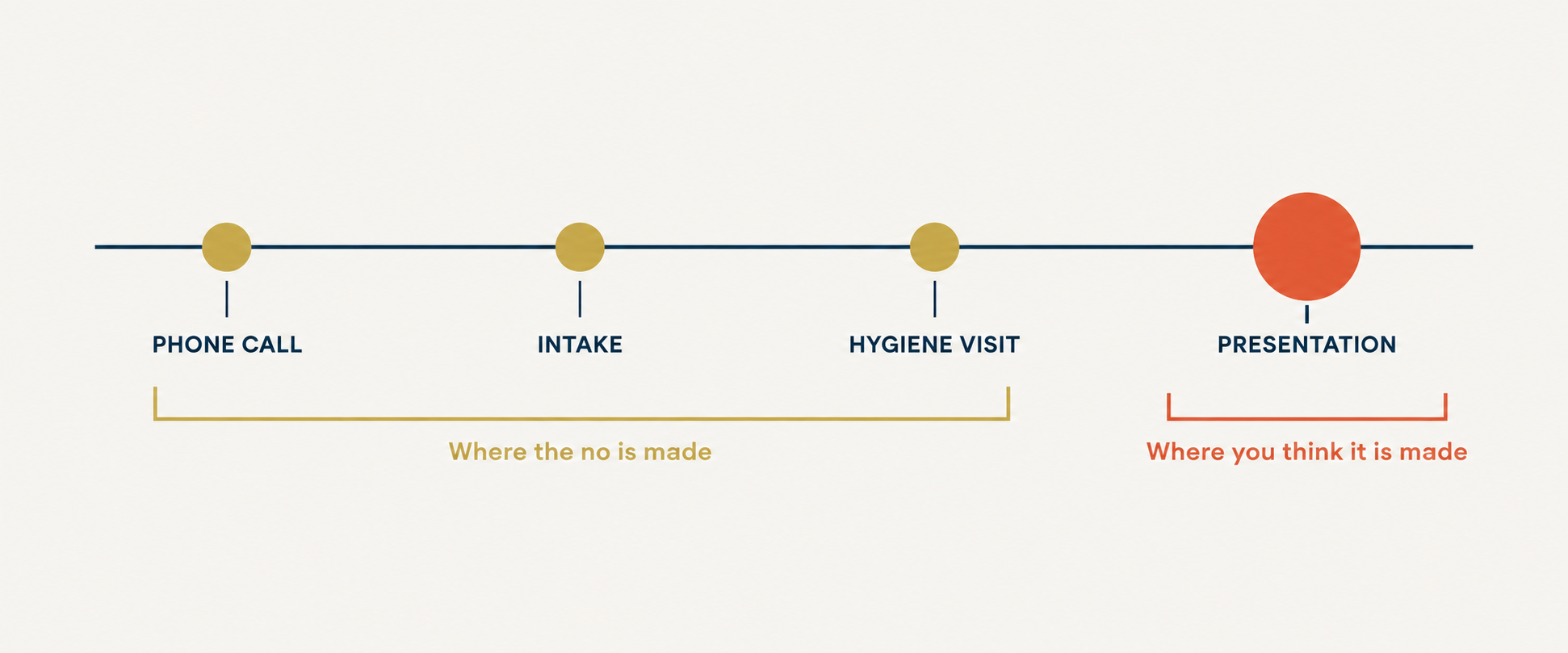
Where the No Actually Gets Made
It is not the patient that makes the experience, it’s the experience that makes the patient.
By the time somebody is sitting in the chair hearing about a crown, most of the decision is already locked. It got made during the phone call, the intake, the hygiene visit, and the exam. Those touchpoints either built a relationship or processed a transaction. A transaction gets declined on price. A relationship gets discussed.
The practices with chronic case acceptance problems are usually doing one of two things.
Running on convenience. I call these practices order takers. The patient comes in with one problem, that problem gets treated, nothing else gets discussed. The schedule bends to whoever calls. There are no standards, so nothing holds, and the patient never gets the sense they’ve entered somewhere with a point of view.
Running on autopilot. The opposite problem. Every patient goes through an identical sequence regardless of who they are. It looks disciplined and it feels processed. Nobody looked up and noticed them specifically, so there’s no relationship to fall back on when the number gets large.
The Sentence That Creates Most Refusals
This is the part most practices won’t want to hear.
If you say one small thing that lets a patient off the hook, they will take it. “We can watch that for now.” “Let’s keep an eye on it.” “Whenever you’re ready.” Each one is a reasonable sentence and each one hands the patient permission to defer.
Later that patient gets described as somebody who got away and missed out on care they needed. Fair enough. But somebody in the building opened the door.
The same thing happens with your team. Make an excuse out loud about the economy or about patients around here not valuing dentistry, and your team hears it. They try slightly less hard afterward, because they’ve just been told the outcome isn’t in the practice’s control.
Scripts That Move a No
These aren’t closing lines. They’re ways of not creating the no in the first place.
When the exam finds something without symptoms:
“I want to show you what I’m seeing so you can decide what to do about it. Right now it isn’t hurting, and that’s exactly why it’s worth looking at while the options are still simple.”
When cost comes up as the objection:
“That makes sense. Before we talk about the number, can I check whether the treatment itself is what you want? Those are two different decisions and I’d rather sort them one at a time.”
When somebody wants to think about it:
“Of course. What specifically would you want to know before deciding? I’d rather answer it now than have you go home with the question.”
Replacing the off-the-hook sentence:
Instead of “we can watch it,” try “here are the two paths and here’s what each one costs you in twelve months.” Same information. One of them is a decision, the other is a delay.
The Refusal You Should Accept
Some patients will say no and they should. Somebody who understands the recommendation, can see the images, knows what deferral costs, and still chooses to wait has made a real decision. That’s their call and it’s a legitimate one.
The refusals worth fixing are the ones where the patient never actually understood what they were turning down. Those aren’t decisions. They’re the practice’s system showing up in the numbers.
Related FAQs
What percentage of dental patients decline recommended treatment?
Industry benchmarks commonly put a healthy case acceptance rate somewhere between 85 and 90 percent, and survey data suggests most US practices fall short of that. The gap is usually wider on complex multi-visit cases than on single-tooth work.
Is cost really the main reason patients refuse dental treatment?
Cost is the most commonly reported reason, but it is often the last available objection rather than the first. Patients who trust the recommendation and understand the consequences of waiting tend to ask about payment structure instead of declining outright.
How do you handle a patient who says they want to think about it?
Ask what specifically they want to know before deciding. “I want to think about it” is usually an unanswered question rather than a refusal, and the question is easier to answer in the room than over the phone a week later.
Should you follow up after a patient declines treatment?
Yes, and the follow-up is frequently the point where the decision changes. A scheduled call rather than a remembered one is what separates practices that recover declined treatment from practices that lose it.
I laied out the full model in The Four Freedoms of Dentistry, the free book covering how DST doctors rebuild the practice around fee-for-service dentistry, lower overhead, and a schedule they own. Download it, or book a Lifestyle Practice Blueprint call to look at where your own case acceptance is actually breaking.