A dental practice is financially ready to drop PPOs when demand exceeds capacity, meaning the schedule stays full without needing insurance volume to fill it. The decision comes down to three numbers: what percentage of collections comes from insurance, the average write-off per crown, and whether new patient flow is insurance-driven or relationship-driven. When those three data points point in the same direction, the transition is a business decision, not a gamble.
The Question Dentists Are Actually Asking
Every week, dentists search some version of the same thing. “Am I ready to go fee-for-service?” “When is it safe to drop Delta Dental?” “How do I know if leaving PPOs will tank my schedule?”
Here’s the honest answer: you’re never going to feel ready. That feeling doesn’t come. What you get instead is a moment where the math is obvious enough that staying in starts to look worse than leaving.
Nearly one in three dentists in the US planned to resign from at least one PPO plan in 2025. That’s not a fringe movement. That’s a structural shift in how dentistry works.
And the dentists who are doing it well aren’t the fearless ones. They’re the ones who stopped asking “am I ready?” and started asking a different question entirely.
The Wrong Question Is Costing You Time
Scott Manning gets this question every single week. And his answer is always the same: you’re asking the wrong thing.
“When is my practice ready to drop PPOs?” is a passive question. It puts you in the passenger seat, waiting for some external signal to wave you through.
The real question is simpler and more uncomfortable. Do you want insurance, or do you want independence?
Those two things can’t fully coexist. Pick one. Because as long as insurance dictates your capacity, your fees, and your treatment plans, you’re not running your practice. You’re running theirs.
What Insurance Actually Does to a Practice
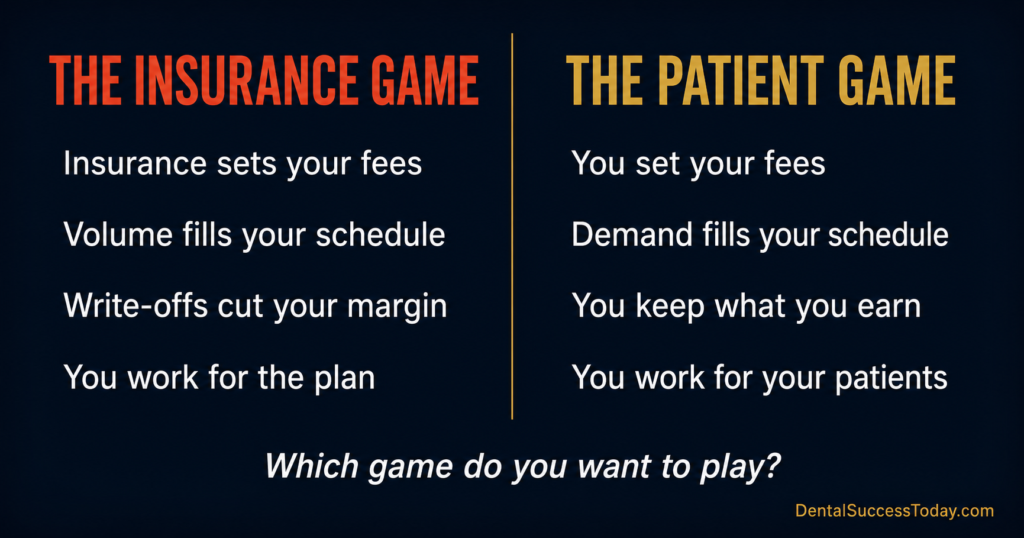
Here’s what most dentists don’t account for. Insurance doesn’t just affect the money column. It gets into everything.
It gets into how your team talks about money with patients. It gets into which procedures you recommend. It gets into how your schedule is built. And it gets into the value patients place on your care, because the moment you discount your work for an insurance company, patients start to see you as a commodity.
PPO reimbursement rates stayed essentially flat through 2025, while overhead kept climbing. Practices that got out weren’t the ones with the biggest marketing budgets. They were the ones that stopped filling their schedules with low-margin patients and started attracting fewer, higher-value ones. The practices making 30 to 40% profit margins weren’t working harder. They were working differently.
Scott describes it plainly: insurance left unchecked tends to spread. It starts as a line item and ends up as a mindset.
The Hierarchy You Need to Understand
Not all insurance participation is equal. Here’s how Scott maps it, from lowest leverage to highest.
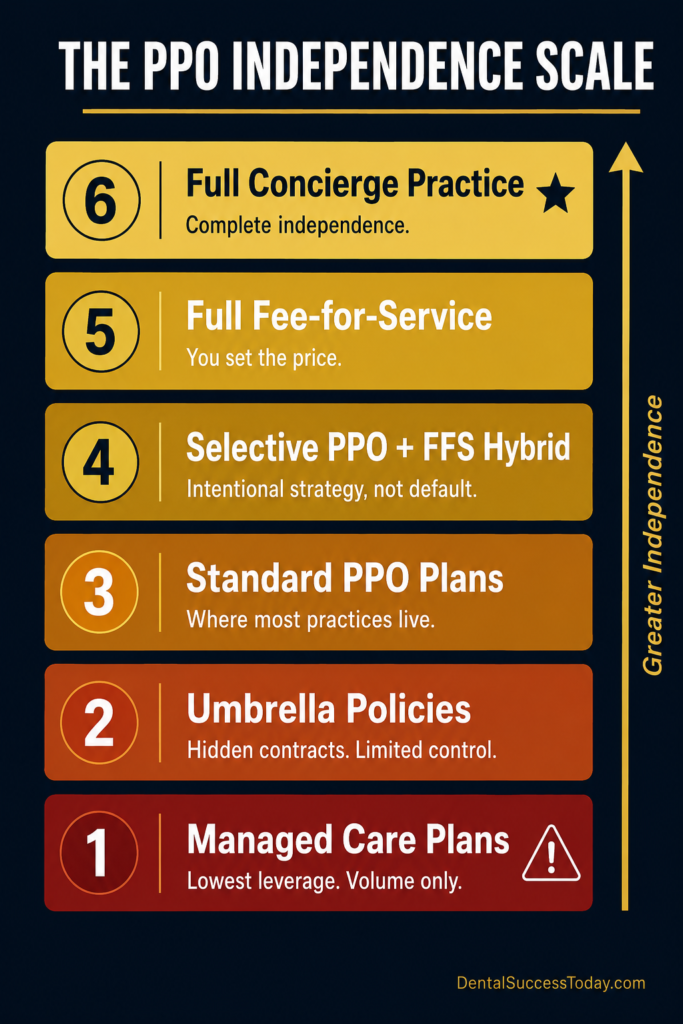
Level 1: Managed Care Plans
The worst position. You accept whatever the plan dictates. Volume is the only lever you have.
Level 2: Umbrella Policies
These look like one plan but often pull several others in underneath. Many dentists don’t know which contracts they’re actually bound by.
Level 3: Standard PPO Plans
Where most practices live. Write-offs are real. Control is limited.
Level 4: Selective PPO + Fee-for-Service Hybrid
Most “fee-for-service” practices actually still carry one or two plans, often the dominant local employer or a civic plan. This is fine as a deliberate strategy, not as a default.
Level 5: Full Fee-for-Service
You set your fees. Patients submit to insurance themselves for whatever reimbursement they can get. You collect full price on everything.
Level 6: Full Concierge / Cash Practice
No insurance involvement at all. Very few practices sit here. The ones that do built significant demand and relationship capital first.
The goal isn’t to jump from Level 2 to Level 6 overnight. The goal is to understand where you are, where the leverage is, and what specific move gets you closer to independence.
The Three Factors That Actually Determine Readiness
Scott calls these the three big considerations. Ignore any one of them and the math won’t work.
1. Capacity
If your schedule is booked out and you’re turning patients away, you are handing money to insurance companies for no reason. You already have the demand. The question is whether you’re extracting full value from it.
If you have 100% of available appointment time and you’re discounting 30% of it for PPO write-offs, you’re giving away 30% of your capacity for free. You don’t need their volume. You’re already full.
2. Value
Patients value you in direct proportion to what they pay. This isn’t a cynical observation. It’s psychology.
When insurance sets the price, it also sets the perceived ceiling on what your care is worth. Going fee-for-service doesn’t just change the revenue number. It changes the relationship. Patients who choose you out of network are self-selected. They’re not price buyers. They’re relationship buyers.
3. Price
This is the leverage lever most dentists never touch.
Production goes up, overhead goes up, and take-home stays flat. That’s the production trap. Price, on the other hand, has an outsized effect on margin. A 10% fee increase doesn’t cost you 10% more in overhead. Most of it flows straight to the bottom line.
As long as insurance sets your price ceiling, you can’t use this lever. That’s the core problem.
The Insurance Matrix: How to Know Which Plans to Drop First
Before pulling any contracts, build what Scott calls the insurance matrix. It’s four numbers for each plan you carry:
- New patients attached to that plan per month
- Average crown value from those patients (not cleanings, crowns)
- That plan’s share of your total collections as a percentage
- Hygiene visit volume tied to that plan
Map every plan against those four numbers. The plans that show up with low crown value, high write-offs, and low new patient count? Gone first. The ones with decent volume and reasonable fees? Those stay until you’ve built the demand to replace them.
This turns an emotional decision into a data decision. And data decisions are easier to execute.
The Process Once You Decide
You’ve got two speeds.
Fast: Send the termination letter. Give the required notice. Start the patient communication immediately with clear messaging about why you’re making the change. Some patients leave. Most don’t. With advance notice and strong patient communication, most practices find patient retention is higher than expected after going out of network.
Slow: Six-month transition. Keep the plan active in hygiene only while you shift new patient flow. Communicate the change well in advance. Layer in a membership program so price-sensitive patients have an alternative before they lose their perceived benefit.
Both approaches work. The slow approach feels safer. The fast approach gets you to independence sooner and removes the temptation to backslide.
Some practices convert the transition into a membership model. Every patient becomes a membership patient. You’re no longer an insurance-dependent practice. You’re a relationship-based, concierge-style practice that happens to offer a membership tier.
The Fear Is Real. But Here’s What Actually Happens.
Will you lose some patients? Yes. Some will leave for a cheaper cleaning. That’s fine. The patients who leave because you stopped discounting your work weren’t building a relationship with your practice. They were building a relationship with their insurance card.
The ones who stay? They chose you. That’s a different kind of patient and a different kind of practice.
A profit-focused practice is a patient-focused practice. A production-focused practice is an insurance-focused practice. There’s no in-between. You’re building one or the other.
Related FAQs
What is the biggest sign a dental practice is ready to drop PPOs?
The clearest sign is a consistently full schedule with a measurable percentage of write-offs. If your appointment book stays full without needing insurance volume to fill it, you’re already generating the demand that makes fee-for-service viable.
Will patients leave if I drop their insurance plan?
Some will. Typically the ones with the lowest treatment acceptance and the shortest average tenure with the practice. Dentists who stay in network usually aren’t unaware of the problem. They’re afraid of the fallout. The fallout is real but manageable when the transition is handled with clear communication and a deliberate patient education process.
What is the difference between PPO and fee-for-service dentistry?
In a PPO model, the insurance company sets your fees and determines what it will approve or pay. In fee-for-service, you set your own fees. Patients may still submit to their insurance for reimbursement, but you collect your full price at the time of service.
How long does it take to transition from PPO to fee-for-service?
A fast transition runs 30 to 90 days. A structured, patient-communication-heavy transition typically takes six months. Dropping multiple plans simultaneously can take up to 12 months for a complete exit depending on contract terms
Stop Playing the Insurance Game.
If you’re serious about building a practice that gives you more time, better margins, and patients who actually value your care, the Lifestyle Practice Blueprint call is where that conversation starts.
Scott Manning works directly with dentists to map out the exact transition, based on your actual numbers, not someone else’s playbook.
Or start with the book. “The Four Freedoms of Dentistry” lays out the full framework: Financial Freedom, Practice Freedom, Relationship Freedom, and Time Freedom.