Profit leaks in a dental practice usually come from insurance write-offs, overhead creep, payment processing fees, and missed appointments, not from a single big mistake. The fastest way to find them is a monthly financial review that checks write-offs, overhead as a percentage of collections, and production by provider, instead of waiting for the annual tax return to reveal what already happened.
Why a Full Schedule Doesn't Mean a Healthy Practice
Here's the trap. The schedule is booked. Claims are going out. Payments are coming in. Everything feels like it's working.
That's exactly when profit leaks are easiest to miss. A busy practice generates enough revenue to cover the leak without anyone noticing the leak is there. The production number looks fine. The actual take-home number tells a different story, and most dentists only see that number once a year, when the CPA hands them the tax return.
Scott Manning's take on this is blunt: you can't manage what you don't monitor. Production reports show you patient flow. They don't show you where the money disappears between the treatment chair and the bank account.
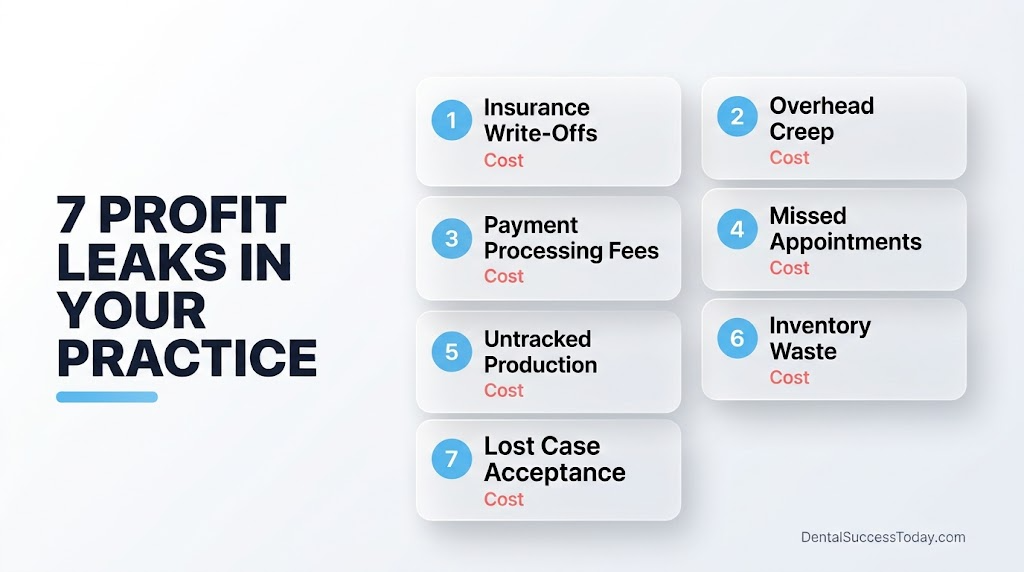
The 7 Places Money Actually Leaks Out
These are the leaks that show up most often when a practice finally runs a real financial audit. Most practices have three or more running at once.
1. Insurance Write-Offs and Missed Claim Follow-Up
Missed claim deadlines, incorrect coding, and late appeals on denied claims are the most common reasons practices lose insurance revenue. Most solo practices rely on one front desk or billing staff member to submit, post, and follow up on claims, with no second check. Industry estimates put total revenue leakage from these gaps at 5 to 20 percent of production a year.
2. Overhead Creep
Overhead creep happens when costs grow faster than revenue, quietly, a few percentage points at a time. A practice that grows from $1.4 million to $1.5 million in production but sees overhead climb from 63 to 69 percent is actually less profitable at the higher number. The healthy range for a general practice is 59 to 65 percent. Above 70 percent, you're keeping a very small share of what you produce.
3. Payment Processing Fees
Most practices sign up with a processor at a competitive rate, then watch it climb 18 months later without noticing. Unnecessary fees, PCI compliance charges, statement fees, gateway fees, batch fees, can add up to $3,000 to $8,000 a year in avoidable cost. Ask yourself right now: do you know your actual effective processing rate? Most practice owners don't.
4. Missed and No-Show Appointments
Every no-show is a chair sitting empty that could have been producing. Practices without automated reminders, a clear cancellation policy, or a waitlist system lose this revenue quietly, appointment by appointment, all year.
5. Untracked Production by Provider
Without tracking production and collections by provider, a practice has no way to see which team members, or which days, are actually driving profitability. This blind spot also makes fair compensation conversations harder than they need to be.
6. Inventory and Supply Mismanagement
Over-ordering, expired materials, and no standardized reorder process quietly inflate the supply line on the P&L. It rarely looks dramatic month to month. It adds up over a year.
7. Case Acceptance Left on the Table
Treatment that's diagnosed but never scheduled is production that never happened. If the practice isn't tracking case acceptance rate by provider, this leak is invisible by design.
The Monthly Profit Leak Checklist
This takes about 30 minutes a month, done consistently. If you answer "no" or "not sure" to more than two or three of these, you likely have an active leak.
- Have you reconciled insurance write-offs against expected collections this month?
- Do you know your effective credit card processing rate right now?
- Is your overhead percentage tracked monthly, not just at tax time?
- Do you know your no-show and same-day cancellation rate for the last 30 days?
- Are production and collections tracked by provider, not just practice-wide?
- Has anyone reviewed your merchant statement for unnecessary fees in the last 12 months?
- Do you know your case acceptance rate for diagnosed but unscheduled treatment?
- Is someone following up on aging claims past 30 to 60 days in accounts receivable?
The Volume Trap vs. the Lifestyle Practice
There are two ways to respond once you see these numbers.
The Volume Trap says: add more patients, add more chairs, add more hours. Outrun the leaks with sheer production. This works for a while. It also means working harder to stand still, because the leaks scale right along with the volume.
The Lifestyle Practice approach is different. Plug the leaks first. The same production, with the write-offs recovered, the overhead controlled, and the fees negotiated down, means more of what you already earn actually reaches your bank account. That's not a growth strategy. It's a math correction, and it's usually the faster path to more take-home pay than chasing new patients.
This is the core of Scott's philosophy: profitability is not the same thing as productivity. A practice can be busy and still be leaking. The fix isn't always "do more." Often it's "stop losing what you already made."
Related FAQs
What percentage of revenue do dental practices typically lose to leaks?
Industry estimates place total revenue leakage, mostly from insurance write-offs, billing errors, and unworked claims, at 5 to 20 percent of production annually. For a $1 million practice, that's $50,000 to $200,000 a year in earned but uncollected revenue.
What's a healthy overhead percentage for a dental practice?
Most general practices should run between 59 and 65 percent overhead. Specialists typically run slightly lower because per-procedure revenue is higher. Above 70 percent, very little of what the practice produces reaches the owner.
How often should I review my practice's financials for leaks?
Monthly. Annual reviews let too much time pass, and a practice can spend six months moving in the wrong direction before anyone notices. A monthly reconciliation of write-offs, overhead, and claims takes about 30 minutes once the process is in place.
Do I need special software to find profit leaks, or can I do it manually?
A manual monthly review using your existing practice management software reports and a simple spreadsheet is enough to catch most leaks. Software can automate the tracking later, but the habit of reviewing the numbers matters more than the tool.
You're Probably Losing More Than You Think.
Most dentists don't find out how much they're leaking until tax season, and by then it's already gone. The Four Freedoms of Dentistry lays out the full framework for building a practice that keeps what it earns, covering Financial Freedom, Insurance Freedom, Time Freedom, and Team-Turnover Freedom.