You build a better dental patient experience by treating it as a system you own rather than a reaction to whoever walks through the door. The practice defines its standards, its process, and its rules before the patient ever arrives, then delivers that process with enough personalization that each patient still feels individually known. Patient behavior, including case acceptance, attendance, and referrals, is an output of that system rather than something you receive by luck.
The Sentence That Changes the Whole Problem
Every dentist wants better patients. Cash-paying, health-focused, ready to say yes to comprehensive treatment. Ask around at any study club and you will hear some version of the same wish.
Scott Manning puts it plainly: it is not the patient that makes the experience, it is the experience that makes the patient.
That single reversal is where most practices lose the thread. If the patient makes the experience, then your results depend on who happens to call. Some months are good, some are bad, and nothing is really in your control. If the experience makes the patient, then your results are a direct readout of what you built. Uncomfortable, maybe. Also the only version where you have any say.
Search this topic and you will find advice about comfortable chairs, sedation options, paperless intake forms, and shorter wait times. None of that is wrong. It is also not the same thing. Amenities are the decor of a house. This page is about the house.
Your House, Your Rules
People walk into your practice voluntarily. Once they are inside, they make decisions by your rules, follow your process, and take their cues from your standards. That should be the most freeing idea in practice ownership, because it means the results you are living with came from inside the building.
No economy, no insurance company, no local competitor, and no political climate is responsible for your case acceptance. Walk out your front door, turn left or turn right, drive across town, and you will find somebody in the same market having a great year. Same patients available. Same conditions. Different house.
So the first question is not how to attract better people. It is this: how clearly defined are your rules?
Most practices cannot answer that. They have habits, not standards. Habits accumulate quietly and nobody ever wrote them down, which means nobody can be held to them and nobody can improve them. Standards are decided on purpose. Ask five team members what happens when a patient asks to reschedule a crown for the third time and you will learn very quickly which one you have.
Why Your Excuses Cost More Than You Think
There is a specific failure mode worth naming, because it does more quiet damage than almost anything else on this page.
When you make an excuse out loud, your team hears it. A patient did not accept treatment and you say the economy is rough, or people around here just do not value dentistry, or that patient was never going to say yes anyway. It feels harmless. It is not. What your team just learned is that outcomes are outside the practice’s control, and people who believe that try a little less hard next time. Not out of laziness. Because effort feels pointless when the result is decided elsewhere.
The same thing happens with patients. Say one small thing that lets somebody off the hook, and they take it. Later you will describe them as a patient who got away and missed out on care they needed. Fair enough. The question worth sitting with is whose sentence opened that door.
This is why language matters more in a practice than most owners realize. Your philosophy is not what is written on the website. It is what gets said in the hallway between operatories when nobody is being careful.
Patient In, Better Patient Out
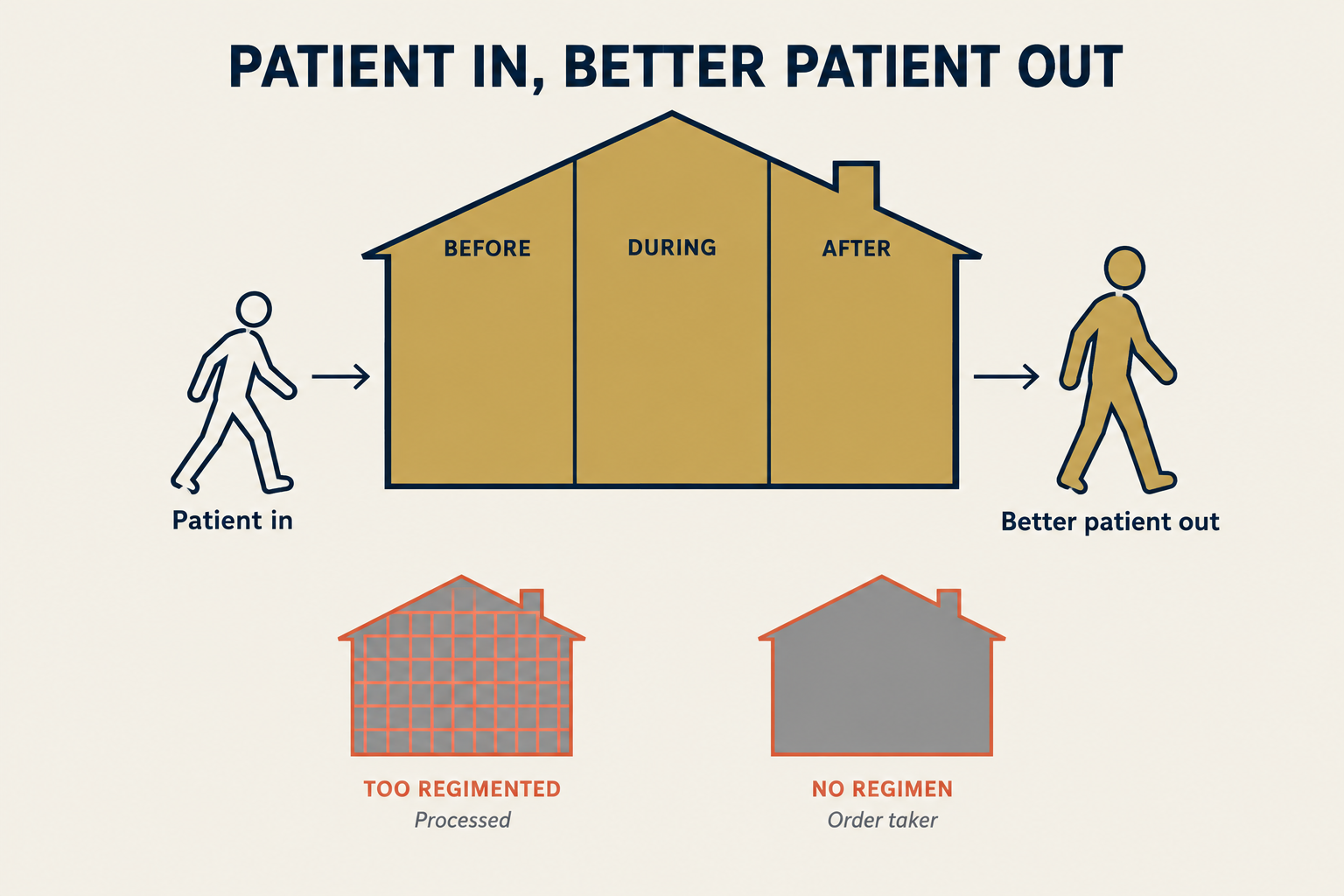
The whole model fits into one line. A patient walks into your house, something happens, a patient walks out. What changed?
Hopefully the answer is you, not them.
That means the patient experience is not a transaction that begins at check-in and ends at checkout. It is a relationship on a continuum, and it runs in three phases. Most practices only work one of them.
Before They Arrive
The experience starts at first contact, which is usually a phone call, a form, or a review someone read at eleven at night. By the time a new patient sits down, they have already formed an opinion about what kind of practice this is.
Work done here shapes everything downstream. What gets said on the phone. What they are asked to bring. Whether anyone found out why they are coming in, what they are worried about, and what they want their mouth to look like in five years. A patient who arrives already understanding that this practice does complete dentistry behaves differently from one who arrives expecting a cleaning and a quote.
While They Are Here
This is the part everybody optimizes, and usually the part with the most existing structure. Morning huddle, exam protocol, photographs, scans, treatment presentation, handoff to the front.
The thing worth auditing is not whether these steps happen. It is whether they happen the same way on a chaotic Thursday as they do on a calm Tuesday. A system only counts when it survives a bad day.
After They Leave
The most neglected phase by a wide margin. The relationship continues until the patient reaches whatever definition of complete health you set for them, and after that, you want them multiplying themselves through referrals.
Practices that stop caring at checkout are rebuilding their patient base from scratch every year. That is expensive and exhausting, and it usually gets misdiagnosed as a marketing problem.
The Two Ways Practices Get This Wrong
Almost every struggling patient experience falls into one of two ditches, and they sit on opposite sides of the same road.
Too Regimented
This practice has systems. It has a lot of systems. This is how we do things here, every time, no exceptions, and every patient goes through the identical sequence regardless of who they are.
It looks disciplined from the outside. The cost shows up in what patients feel, which is processed. No customization, no emotional connection, no sense that anybody looked up and noticed them specifically. Practices in this ditch capture the bottom slice of available opportunity and miss the large majority of it, because the cases that require trust never get to the trust part.
No Regimen At All
The opposite ditch, and more common in practices that pride themselves on being friendly. Scott calls these order takers.
A patient calls and wants to move an appointment, so the schedule moves. Somebody shows up with one problem and that problem gets treated and nothing else gets discussed. The day is built entirely around patient convenience, the doors are wide open, and everybody inside does more or less what they want. There are no rules, so nothing holds.
This is also the ditch where insurance-driven scheduling does the most damage, because a practice with no standards of its own will accept whatever standards the payer supplies.
The Harmony In The Middle
Neither ditch works, and the answer is not a compromise between them. It is a specific combination: a standardized, principle-based process delivered through a personalized, high-touch relationship.
Every patient goes through the same architecture. Every patient feels like the only one in the building. Those are not in tension once you separate the process from the delivery.
The test Scott gives is worth writing on a wall. Do they feel welcome and like they belong? And do they conform and comply? A practice that only manages the first is friendly and broke. A practice that only manages the second is efficient and forgettable. You need both answers to be yes.
Model, Mindset, and Math
When the experience is not producing what you want, the cause sits in one of three places.
Model. How the practice is built. What you treat, who you take, how the schedule is designed, what the day is supposed to produce. A practice built for volume will produce volume outcomes no matter how warm the team is.
Mindset. What you believe about patients, about your own value, and about what is within your control. This is where the excuses live, and it is the layer that quietly overrides the other two.
Math. The numbers that tell you whether any of it is working. Production per visit, case acceptance, hygiene reappointment, overhead. Without the math you are guessing about the model, and guessing feels like intuition right up until the year closes.
Most owners try to fix a model problem with more effort, or a mindset problem with a new software subscription. Naming which of the three is actually broken saves months.
What This Looks Like In A Normal Week
The philosophy is only worth something if it changes Tuesday. Practically:
- Your rules exist in writing, and the team could recite the important ones without looking
- Every new patient conversation covers what they want and why before anyone presents a plan
- The full exam happens the same way regardless of what insurance will reimburse
- Somebody owns the before-arrival contact, and it is a defined process rather than whoever picks up
- Reschedules and no-shows get a consistent response instead of a case-by-case shrug
- The team hears you take ownership out loud when something does not go well
- Post-treatment follow-up is scheduled, not remembered
- You review the math monthly, on the same day, whether or not you want to see it
None of this needs new equipment. It needs decisions, made once, on purpose, and then held.
The Question Worth Sitting With
A patient walked into your house last Tuesday and walked back out. What was different about them on the way out?
If the honest answer is nothing much, that is not a patient quality problem. That is the house.
Ownership is the whole lever here. Not just for the building and the schedule, but for the people inside it and what happens to them while they are yours. Where a practice has that kind of control, it tends to have profit too, because the two come from the same source.
Related FAQs
What actually counts as the dental patient experience?
It covers every interaction from the first phone call or website visit through treatment and follow-up care, including how the schedule is run, how treatment is presented, and how the team responds when something goes wrong. It is broader than in-office comfort, which is only one piece of it.
How is this different from just improving customer service?
Customer service is how patients are treated. The patient experience as a system also decides what gets diagnosed, what gets scheduled, and what behavior the practice accepts. A practice can have excellent service and still produce poor outcomes if it has no standards behind the friendliness.
Can you have standardized systems without patients feeling processed?
Yes, and that combination is the goal. The process stays consistent while the delivery adapts to the individual patient. Patients should move through the same architecture every time and still feel that someone paid attention to them specifically.
How long does it take to see results from changing the patient experience?
Practices that change intake, diagnosis, and follow-up habits consistently tend to see movement in case acceptance and reappointment rates within one to two quarters. The changes that stick are the ones written down as standards rather than announced once in a team meeting.
Scott lays out the full model inside The Four Freedoms of Dentistry, the free book covering how DST doctors rebuild the practice around fee-for-service dentistry, lower overhead, and a schedule they actually own. Download it, or book a Lifestyle Practice Blueprint call to map out which of the three layers is costing you the most right now.