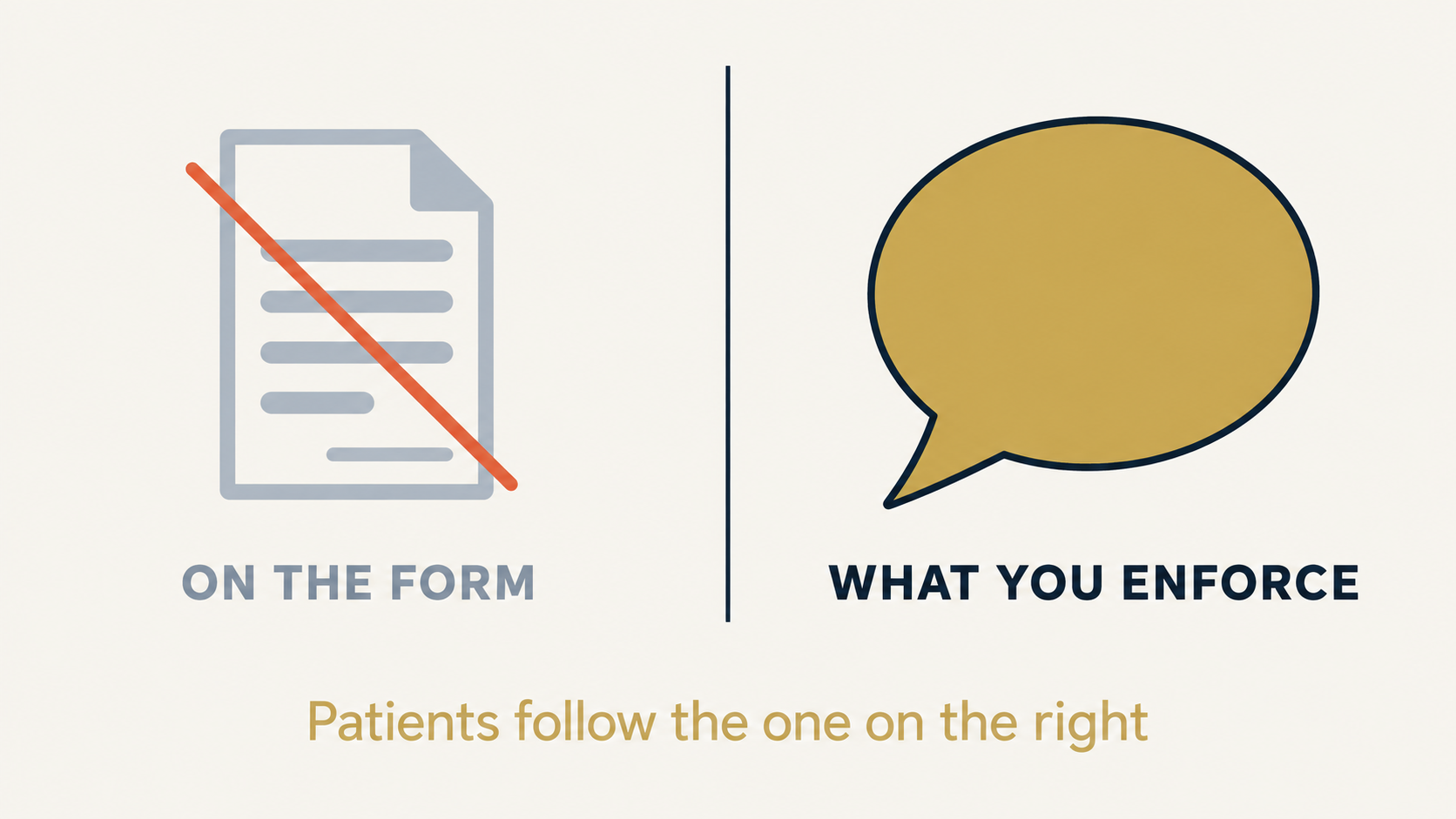
Setting standards in a dental practice means deciding, in writing, how scheduling, payment, and clinical care work in your office, then stating and enforcing those rules the same way for every patient. Patients follow the standards a practice actually enforces, not the ones printed on the intake form. When the two don’t match, the enforced version wins.
The Policy on the Form Is Not Your Policy
Almost every practice has a cancellation policy. Most of them live on a form the patient signed at their first visit, and nobody has mentioned them since.
Your real policy is whatever happened the last time a patient cancelled a crown seat at 7:40 on the morning of the appointment. If the front desk said “no problem, when works better for you?” and rebooked her for next Tuesday, that’s the policy. She learned it. So did the two team members standing close enough to hear.
Patients aren’t being difficult when they ignore a rule. They’re following the one you taught them. The research on missed appointments points the same way. A systematic review of 105 no-show studies across healthcare found that a patient’s own history of missing appointments was one of the most consistent predictors of the next miss, along with booking appointments far in advance. Whatever went unaddressed last time becomes the pattern.
Scott has a shorter way of putting it. What you tolerate, you train.
Your House, Your Rules
On the patient experience pillar page, Scott makes the case that people walk into your practice voluntarily and then make decisions by your rules. That idea only helps if the rules exist.
A practice without written standards doesn’t run without rules. It borrows them from whoever shows up. The patient who calls first sets the schedule. The plan with the thinnest fee schedule decides how long the exam takes. Whoever is loudest at the front desk decides what counts as an emergency.
That’s the Volume Trap. The day bends around every request, the doctor spends it reacting, and production depends on who happened to call that week. A Lifestyle Practice runs the other way. The standards come first, and the schedule gets built around them.
Where to Set Standards First
You don’t need a 40 page manual. Start where your practice currently gives away the most control.
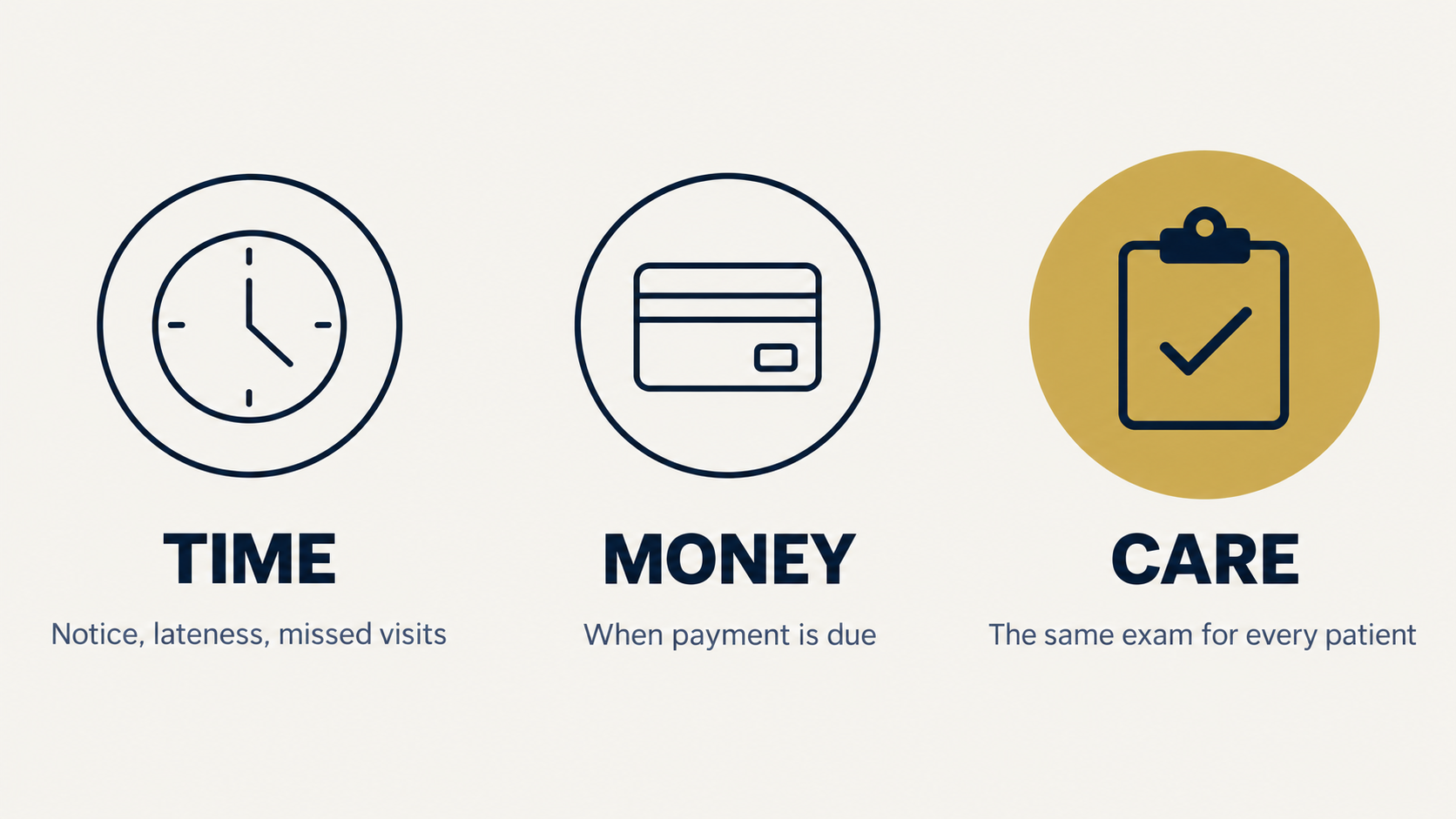
Time
Scheduling standards decide who controls the calendar. Write down:
- How much notice you need to move an appointment, and what happens with less
- What counts as late, and whether a late patient still gets the full procedure
- What happens after repeat no-shows. Heather Colicchio, founder of the American Association of Dental Office Management, recommends moving patients with two recent no-shows onto a short-notice list for last-minute openings instead of booking them into prime time again.
- How far ahead you pre-appoint, and how those visits get confirmed. Long lead time is one of the strongest no-show predictors in the research, so a recall booked eleven months out needs a real confirmation step, not just a text the night before.
Money
Financial standards decide whether treatment gets paid for on your terms or the patient’s. The ADA’s own guidance recommends putting these answers in writing so every patient hears the same thing:
- When the patient’s portion is due
- What deposit starts a multi-visit case
- What happens if a patient pays for part of a treatment plan and doesn’t finish it
- Which payment and financing options you offer
Care
This is the standard most practices never write down, and it’s the one that matters most.
- Every new patient gets the same comprehensive exam, whatever their plan reimburses
- Findings get shown with photos or scans, not just described
- Treatment gets sequenced by clinical need, not by how much annual maximum is left
Skip this one and the insurance company writes it for you. When a plan decides what gets diagnosed and when, the plan is setting your standard of care.
How to Get Patients to Actually Follow Your Standards
A written standard is only the starting point. Whether patients follow it comes down to how the practice says it and whether the practice holds it.
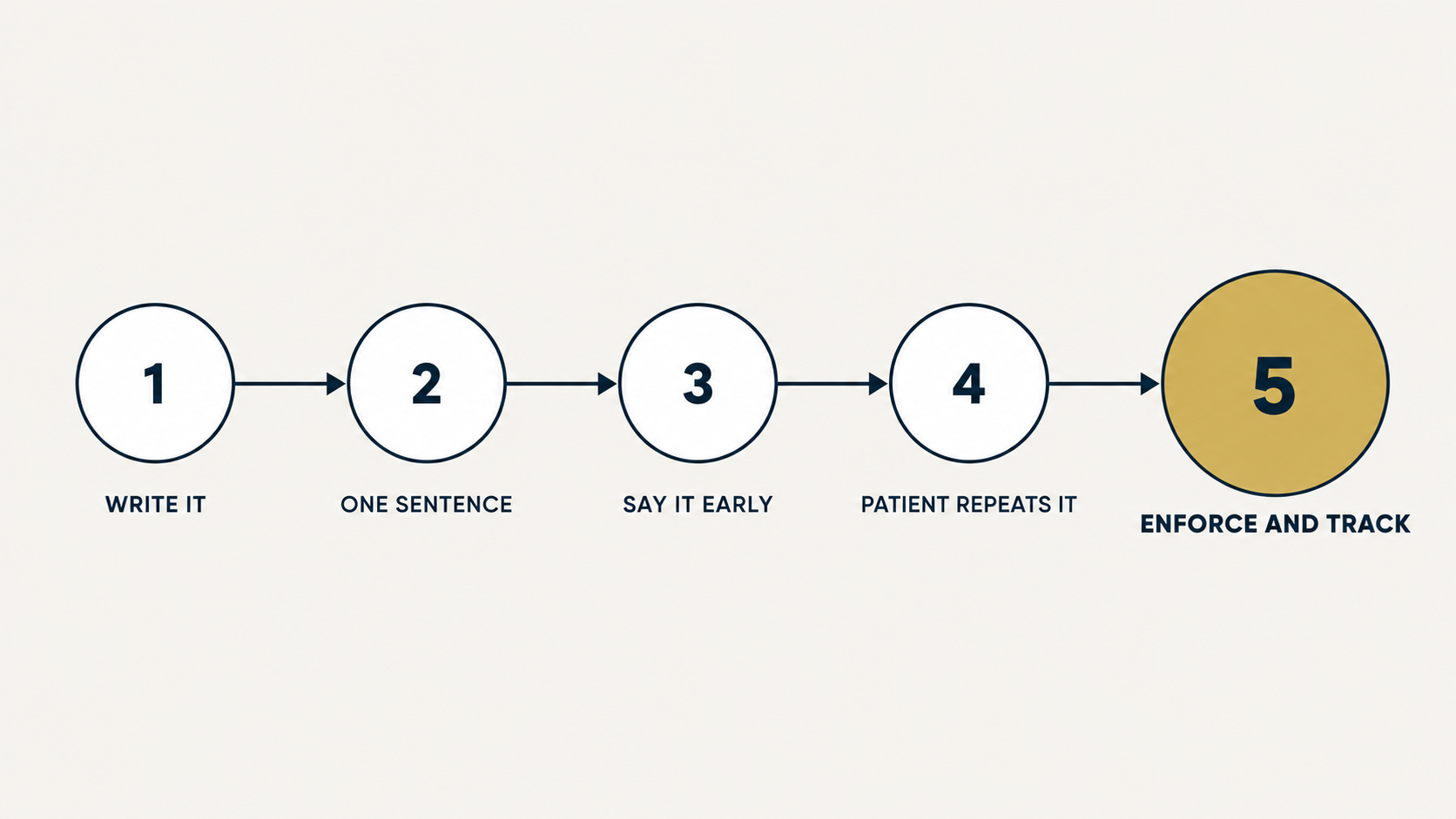
Get Each Standard Down to One Sentence
If a team member can’t say the policy out loud in one sentence without softening it, you don’t have a policy. You have a preference.
Something like: “We need 48 hours’ notice to move an appointment, because that time is held for you and we can’t offer it to anyone else on shorter notice.”
That sentence works because the reason is already inside it.
Say It Early, With the Reason
“That’s our office policy” lands like a closed door. A reason given at booking lands as respect for the patient’s time and everyone else’s. Nobody likes hearing about a rule for the first time at the exact moment they’ve broken it.
Have the Patient Say It Back
In a study across two NHS health centers, asking patients to repeat their appointment date and time back before hanging up cut missed appointments by 3.5%. Having patients write their own appointment card, instead of the nurse writing it for them, cut missed appointments by 18%. Combined with waiting room signs showing how many patients did attend, missed appointments fell 31.7%.
Two details from that study are worth more than the headline numbers. The first version of the experiment failed because the front desk staff weren’t following the new process. And the researchers replaced the old signs that announced how many patients missed appointments, because they suspected those signs made missing sound normal. If your waiting room tells patients how many people no-showed last month, take it down.
Keep Your Own Standard First
If the doctor routinely runs 25 minutes behind without a word, the 48 hour rule loses its authority. Patients notice when a practice asks for respect for its time and doesn’t give any back, and they adjust their behavior to match.
Enforce It the Same Way Every Time
One exception rarely costs just one appointment, because the team watches how it was handled and copies it next time. Decide in advance who can approve an exception, usually the owner or office manager, so the front desk isn’t negotiating alone on the phone.
Listen to the reason, too. Patients sometimes cancel because of fear or money and give a scheduling excuse instead. A patient who has moved the same crown prep three times usually has a case acceptance problem, not a calendar problem.
Be careful about leaning on fees to do the work. They have a place, but the same NHS study authors cite research from day care centers where fining late parents actually increased lateness. A fee can turn a commitment into a price. Clear expectations do more of the work than the charge does.
Track It, or It Isn’t a Standard
CDT includes two codes for this: D9986 for a missed appointment and D9987 for a cancelled one. Record every instance, whether or not you charge for it, and review the count monthly alongside the rest of your practice metrics. If the number hasn’t moved after 60 days, look at enforcement before you rewrite the policy.
Where Your Rules Stop
Standards give you control over your practice. They don’t override the law or the contracts you’ve signed.
Medicaid patients. Medicaid programs generally don’t allow practices to charge beneficiaries for missed appointments. The Massachusetts attorney general sued a dentist who required MassHealth patients to sign an agreement with a fee for missed or late-cancelled visits.
PPO contracts. Many participation agreements cap missed appointment fees or require written notice first. A policy on your intake form doesn’t override a contract you signed, which is one more way the payer ends up writing your rules.
Equal application. Whatever the standard is, apply it to every patient the same way.
Dismissing a patient. The ADA says a dentist can dismiss a patient when differences can’t be resolved, as long as the reason isn’t discriminatory, and notes that state rules may require you to stay available for emergencies for a period afterward. Section 2.F of the ADA Code of Ethics says that once treatment has started, a dentist shouldn’t stop without adequate notice and a chance for the patient to find another dentist.
This section is general information, not legal advice. Check your state dental board rules, your payer contracts, and a healthcare attorney before introducing missed appointment fees or a dismissal policy.
Where to Start This Week
Pick the one area where your team softens most often. Write that standard as a single sentence, say it at every booking for the next 30 days, and log every D9986 and D9987. By the end of the month you’ll know whether you have a patient problem or a consistency problem.
Related FAQs
Can a dentist charge a fee for a missed appointment?
Often yes for private-pay patients, as long as the policy was given in writing before the appointment and applied to everyone. Medicaid programs generally prohibit charging beneficiaries, and many PPO contracts restrict these fees, so check your payer agreements and state rules first.
What policies should a dental office have in writing?
At minimum, a scheduling policy covering notice, lateness, and missed appointments, a financial policy covering when payment is due and what happens with incomplete treatment, and a clinical standard for how every new patient exam is done. Each one should fit in a single sentence a team member can say without softening it.
How do you get the front desk to enforce practice policies?
Give the team a one-sentence version of each standard, decide in advance who approves exceptions, and back them up when they hold the line. Front desks usually soften a policy when they aren’t sure the doctor will support them.
When can a dentist dismiss a patient?
ADA guidance allows dismissal when differences can’t be resolved or behavior can’t be accepted, as long as the reason isn’t discriminatory. Give proper written notice, check your state’s emergency availability rules, and don’t stop mid-treatment without giving the patient a chance to find another dentist.
Scott lays out the full model in The Four Freedoms of Dentistry, the free book on how DST doctors rebuild the practice around fee-for-service dentistry, lower overhead, and a schedule they own. Download it, or book a Lifestyle Practice Blueprint call to find out which of your standards is quietly being written by someone else.