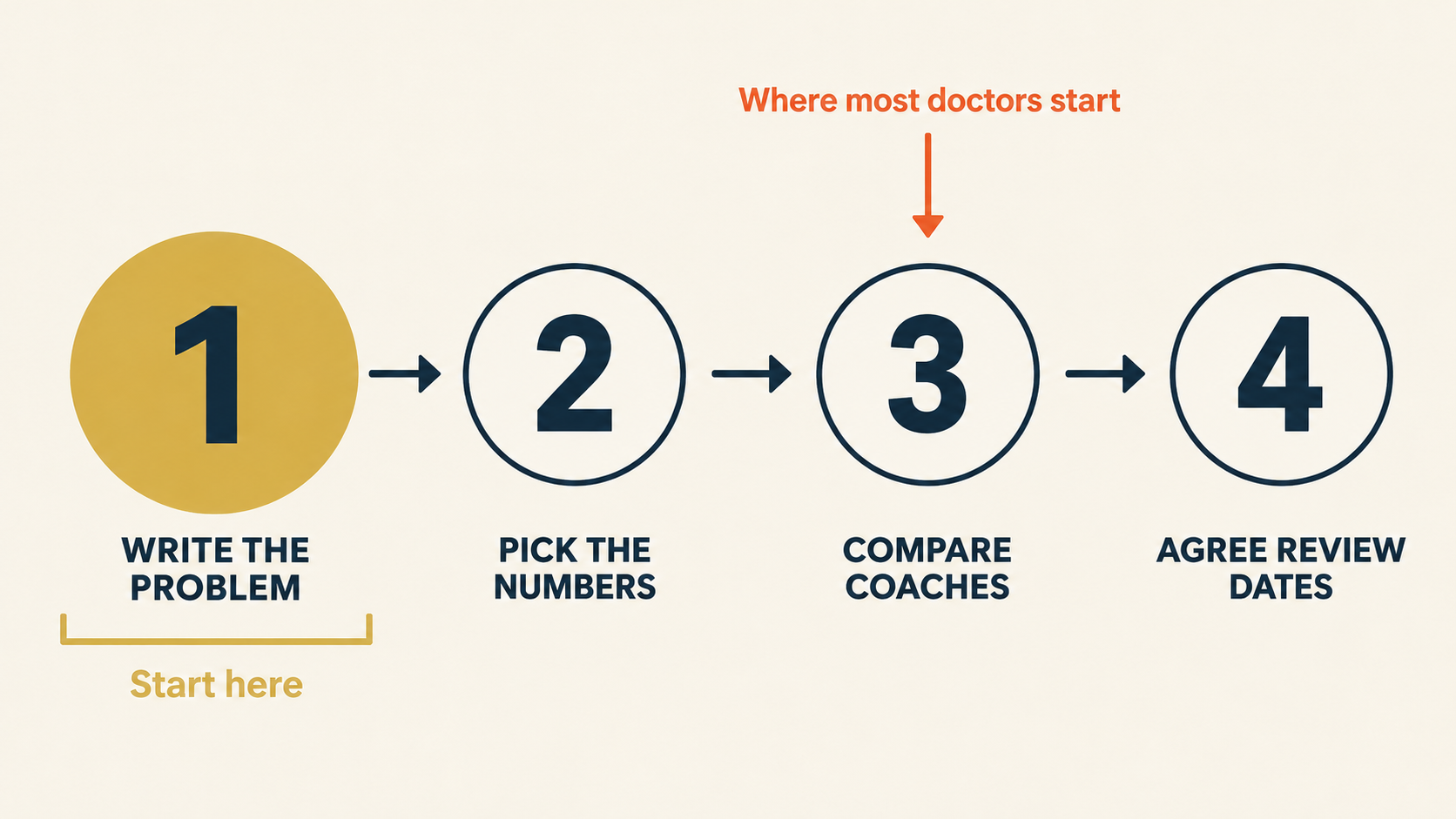
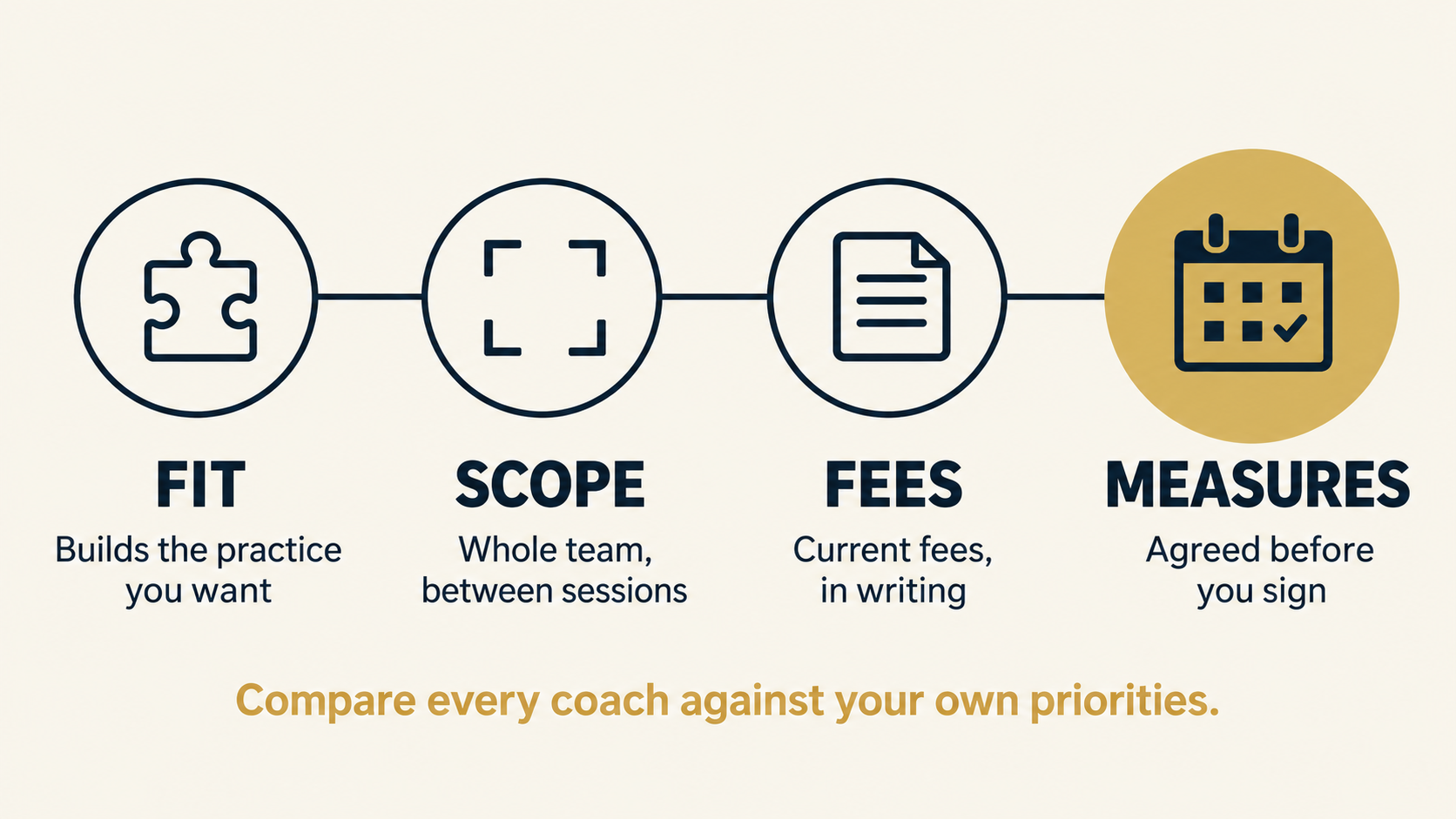
Choose dental practice management coaching by starting with your own priorities, not with a list of coaches. Write down the one or two problems you want fixed and the numbers that show them, then compare coaches on fit, scope, and fees against those problems. Before you sign, agree in writing how and when you’ll review progress.

Why Most Doctors Pick a Coach Backwards
Most dentists find a coach the same way. A colleague mentions a program at study club, a speaker holds the room for forty minutes, or the same ad shows up three times in one week. You book a call, the call goes well, and you sign. Six months later you’re not sure what you bought.
The coach usually isn’t the problem. Nobody wrote down what the coaching was for. If you can’t name the problem, you can’t tell whether a program fits it, and you can’t tell later whether it worked.
A randomized trial of coaching in healthcare has a useful detail here. In a 2019 Mayo Clinic pilot study, 88 physicians were randomly assigned to professional coaching or no coaching. The coached group got about three and a half hours in total over roughly five months, and the first session went to assessing needs, setting goals, and building an action plan. Overall burnout in the coached group fell by 17.1 percentage points, while it rose by 4.9 points in the group without coaching.
That was well-being coaching for physicians inside one organization, and the doctors volunteered, so treat it as a signal rather than proof for dentistry. The signal is still worth having. The work started with goals, before anything else.
The Coach Has to Fit the Practice You Want
Every coaching program carries a picture of what a good practice looks like, whether it says so or not. Some are built for volume: more new patients, more chairs, more hours, and a schedule filled by whoever calls first. I call that the Volume Trap. If that’s the model underneath, the coaching will teach volume habits, however good the coach is.
A Lifestyle Practice runs the other way. You decide the schedule and income you want, then build the numbers, the insurance decisions, and the team around them. If you’re planning a move toward insurance independence, a coach built around PPO volume will pull you in the wrong direction. Ask which model a coach is building before you ask anything else.
Set Your Practice Priorities First
Do this before you book a single call.
Name the Problem in One Sentence
Write the problem the way you’d say it to a colleague. “My schedule is full and my take-home hasn’t moved in three years.” “I’m in nine PPO plans and I don’t know which ones to drop.” “My hygienists keep leaving.” If it takes a paragraph, you’re describing several problems, and you’ll need to rank them.
It helps to sort the problem into Model, Mindset, or Math. Model is how the practice is built: what you treat, who you take, how the schedule is designed. Mindset is what you believe about patients, about your own value, and about what’s in your control. Math is the set of numbers that tells you whether any of it is working. A coach who is strong on scripts and weak on numbers won’t fix a math problem.
Pick One or Two Freedoms to Work On
Every plan I build sits on the Four Freedoms: Insurance Freedom, Financial Freedom, Time Freedom, and Team-Turnover Freedom. You can’t work on all four at once with any depth. Pick the one or two your one-sentence problem points to. That choice tells you what kind of coaching you actually need.
Write Down the Numbers You Want to Move
Pick two or three numbers that would change if the problem got better, and write down where each one is today:
- Your daily production target, against what you actually produce on a normal day
- Case acceptance by value: dollars scheduled divided by dollars presented
- Overhead as a share of collections, which is where most profit leaks show up first
- How many team members left in the last twelve months
- The share of collections that comes from PPO plans
If you can’t pull these in an afternoon, that’s your first finding, and it’s worth knowing before you pay anyone.
Compare Coaching Options on Fit, Scope, and Fees
With your priorities on paper, every coach gets the same test: how would their work address these specific problems?
Coach or Consultant?
The two labels overlap in dentistry, and plenty of firms do both. A consultant usually diagnoses and builds systems: an audit, a report, a set of new protocols. A coach usually works alongside you and your team over months so the changes stick. Neither is better in general. If you already know what to change and keep not doing it, you need coaching. If you don’t know what to change, you need diagnosis first. Ask each firm which one they’ll actually do for you.
Ask Every Coach the Same Questions
Use the same list on every call so you can compare the answers side by side:
- How would you approach the problem I’ve written down, and what would we work on in the first 90 days?
- Do you work with my whole team or only with me?
- What happens between sessions?
- Which practice model do your doctors usually move toward?
- How will we measure whether this is working, and when?
- Can I speak with two doctors you’ve worked with who had a problem like mine?
Listen for answers that start with your numbers. A pitch that sounds the same no matter what problem you describe is a template.
Get Current Fees and Scope in Writing
Ask each coach for current fees and exactly what those fees include: the number of sessions, who attends, support between sessions, any events or materials, and the length of the commitment. Then put the quotes side by side against your budget and against what the problem costs you now. Compare scope, not just price. A cheaper program that covers half your problem isn’t cheaper.
Ask how you leave, too. What’s the cancellation process, is any part of the fee non-refundable, and does the agreement renew automatically?
Notice How They Work With People
Fit is partly personal. You’ll be telling this person where the practice is struggling, and your team will work with them for months. On the first call, notice whether they ask more than they talk, and whether they’re straight with you about what they don’t do.
Agree How You’ll Review Progress
Coaching can’t promise a result, and you should be wary of anyone who does. What you can agree on is how you’ll judge it.
Record Your Starting Numbers Before Day One
Take the two or three numbers from your priority list and write today’s value next to each one, with the date. Share the sheet at the first session. Without a starting point, every review turns into a conversation about feelings.
Put Review Dates on the Calendar
Set the review dates when you sign, not when something feels off. A reasonable rhythm is a check at 30 days on whether the work has started, at 90 days on whether habits are changing, and at six months on whether the numbers are moving. Some numbers move slowly. Insurance changes can take a year or more, so agree which numbers you expect to move by which review.
Review Systems and Leadership, Not Just Revenue
Revenue lags. The earlier signs show up in how the practice runs. Are huddles happening every morning? Is case acceptance training on the calendar every month? Is diagnosed treatment getting scheduled before patients leave? Are people staying? Patient experience belongs on this list too: fewer last-minute cancellations, fewer complaints, more patients finishing the treatment they started. If none of these have moved by the 90-day review, say so, and ask the coach what changes next.
Where Your Rules Stop
Patient records. If a coach will see patient information through your practice management software, schedules, or charts, HIPAA can treat them as a business associate. HHS lists consulting and management among business associate services, and the practice needs a written business associate agreement before sharing protected health information. Ask for one before onboarding, or keep the coaching to de-identified reports.
Contracts. Read the cancellation terms, any non-refundable fees, automatic renewals, and any limits on using materials after you leave. Have a healthcare attorney review a long or expensive agreement before you sign it.
Promised results. Be careful with anyone who names a production number or profit margin before seeing your numbers. That’s selling, not diagnosis.
This section is general information, not legal advice. Check your state dental board rules, HIPAA obligations, and a healthcare attorney before signing a coaching agreement or sharing patient data with an outside firm.
Where to Start This Week
Set aside 45 minutes this week. Write your one-sentence problem, pick one or two Freedoms, and write down today’s value for three numbers. Then book calls with two coaches and ask both the same six questions. Put the answers next to each other in one table. If you can’t tell them apart on paper, you don’t have enough information yet, so ask more before you sign anything.
Related FAQs
How much does dental practice management coaching cost?
Fees vary widely with scope, length, and how much of the team is involved, so ask each coach for current fees in writing. Compare what each fee includes and how long you’re committing, then weigh it against what the problem costs your practice now.
How long does dental practice coaching take to show results?
It depends on the problem. Habits like huddles and treatment follow-up can change within weeks, case acceptance and overhead usually take a few months to show in the numbers, and moving away from PPO plans can take a year or more. Agree up front which numbers you expect to move by each review date.
Does a dental practice management coach need to be a dentist?
Not necessarily. What matters is that the coach understands how a dental practice runs and makes money, and can work from your specific numbers. In the Mayo Clinic coaching trial for physicians, the coaches were not physicians.
What is the difference between a dental practice coach and a consultant?
A consultant usually diagnoses problems and builds systems, often through an audit and a set of recommendations. A coach usually works alongside the doctor and team over months to make the changes stick. Many firms do both, so ask each one what they will actually do for your practice.
I lay out the full model in The Four Freedoms of Dentistry, my free book on how the doctors I work with rebuild the practice around fee-for-service dentistry, lower overhead, and a schedule they own. If you want to see what working together looks like, here’s how we work with doctors. Download the book, or book a Lifestyle Practice Blueprint call and bring the one-sentence problem you wrote this week.